

by Theodore Kim
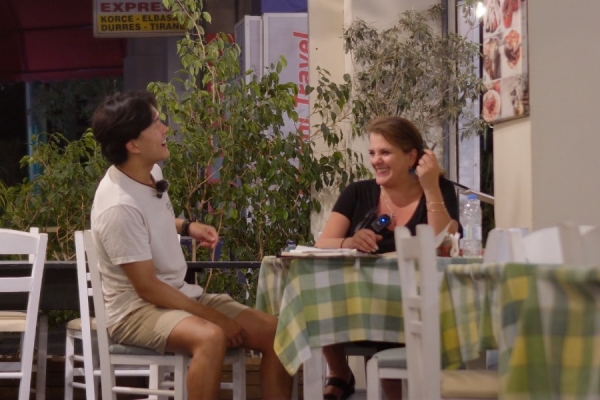
I met Xenia on one of my first nights in Athens. I was out late and it was the only restaurant open in the area and I was dying for some kind of sustenance wandering the streets of Omonia at one in the morning (which I would not advise). It was then that I met Xenia, her cousin Temi, and Helene sitting under the warm al fresco lighting of Grill House Central, parked in the heart of the roundabout that is the unofficial capital of the Metaxourgeio area. They were closed but still made me a plate and we shared a cigarette and the pork gyro that brought me back to life. Throughout my stay in Athens, Grill House Central became a staple of my trip: always there for a late night snack, an oasis in the hellish heat of July. I got to know the family (by blood and by bond) that worked there and I was lucky enough to be able to interview Xenia on my last night in Athens.
Xenia is a busy woman. Throughout our interview she was constantly working, leaving for stretches at a time to tend to business in the back of the house only to come back and continue right where we left off. People turned to her for questions, she counted the bills in one hand while smoking her menthol cigarette in the other. She yelled orders, welcomed new customers in, and counted the bills—all with the unique charm that only a South African Greek can display. Though it was her boyfriend who opened the restaurant and brought Xenia to Athens, Grill House Central runs as a matriarchy.
At one point during our conversation Koula, the kind Greek woman who works in the kitchen and doesn’t speak a word of English (we communicated with head nods and hand gestures), came out with a plate in her hand and berating questions at me in Greek. What? Why? Xenia turned to me and translated her gestures,
“She’s wondering why you didn’t like the feta in phyllo.”
Her evidence: I had left a chunk of the pastry on the plate. I had to frantically explain in my rudimentary Greek that I loved it, I just couldn’t finish the whole thing (it was a multi-person appetizer). She gave a sigh of relief, a laugh, and squeezed my shoulder before returning to the kitchen.
“Remember, you're not allowed to work and eat. You've got to savour what you're doing.”
Regardless of what she does, Xenia believes that doing it wholeheartedly is what’s important. It’s what’s the defining characteristic of the Greek identity. “For me, being Greek, is 101% for... If you love something, if you hate it, if you're angry with it, it's 101%. It's not half measure in anything you do. So even in your world, you do it 100%.” To love wholeheartedly, to fight wholeheartedly; emotions move uninhibited in Grill House Central. In the end, what matters to Xenia are the simple things: joy, passion, family, love. When I asked what made her feel fulfilled, she told me, “Joy. When I see other people, people I care about, people in general, kindness. When I see happiness in others, it makes me happy. It fulfills me, do you understand? It makes me happy.”
Below are excerpts from our conversation. She and I smoked Karelia cigarettes and talked about everything and everything she had on her mind, spoken in the language of Xenia: the okays and the alrights and the “I must be honests” and the endearing way she tells stories, free and flowing. I love the way Xenia approaches her life: not knowing what’s coming next and accepting that, unapologetically loving and caring for your community, dancing when you feel the desire to. It’s a life motivated by passion. I noticed during our talk she calls her struggles “up-downs” and her joys “ups,” cause everything works itself out eventually. Do yourself a favor and visit Grill House Central in Metaxourgeio while you visit Athens. Have the feta in phyllo with a pork souvlaki portion, make sure to finish it, and if you can have a chat with Xenia. You’ll be welcomed like a long lost member of the family.
Conversation with Xenia
Theo: So my first question, and you can take it however you want, is who are you and what do you do?
Xenia: Who am I? I'm Xenia. I'm a girl from South Africa with Greek heritage. I've always loved people, and I love the tourism trade. And that's it. Wherever I can find work, or wherever I can open a work that's got to do with tourism and people, that's me. I love people. I think you’ve picked it up.
Theo: I have. And I actually can't remember what brought me here in the first place. But I’ve just kind of started coming here often enough that we just...
Xenia: I've been told by my customers that apparently I draw them in. From the time I say hello to them, they say they’re addicted. I'm very blessed because I seem to get along with people, right? I have a lot of customers here that come back. They've been coming back four, five years. In fact, today another customer phoned me. She's coming back again today. They're staying in Glyfada, but they've travelled just to come and have a lunch or dinner with me and just to see me a little bit. You know what I mean? It's an amazing compliment. It makes you feel good that you actually can... What's the word? That you have that type of reaction with people. I've met a lot of people through this shop, particularly, from all over the world. And we’re friends still today.
Theo: I'm so lucky that I got a place like right over there. And I can come here every day.
Xenia: Really? I also stay quite near you.
Theo: I live right over there.
Xenia: Which one? That one there.
Theo: It might be a street over actually. But it's across from the theatre here. (...) Should we light them up?
Xenia: Yeah, do you want one? They’re quite nice.
Theo: Yes, please. Awesome.
Xenia: I love Karelia because I love menthol. But unfortunately they've stopped menthol in Europe, but this one's got a bit of menthol in it, and I’ve found it.
Theo: Wait, but I've seen like this little menthol, like you put it at the end of the cigarette. You put it on the end of the cigarette. The filters.
Xenia: They've got the menthol filters, but they don't have menthol cigarettes anymore.
Theo: Yeah, but you don't roll them up yourself.
Xenia: No, no. My cousin does, I don't. I’ve tried, but I don’t get it. I'm terrible at it. (...)
Saying Goodbye to Home
Theo: So you're from South Africa and have Greek heritage.
Xenia: That's right.
Theo: How did you end up here, specifically in Athens? And what is that story like? I've gotten a little hints of it, but...
Xenia: Okay, so what actually happened was I was held up eight times in South Africa. Unfortunately, the crime is a bit [rough], and I'd been thinking of immigrating. But I wasn't 100%, I must be honest. Then I came to Greece because a friend of mine was terminally ill and I came to say bye-bye to her. And while I was in Greece, I met the boyfriend. We were dating, then after I went to Patras I was in Athens. While I was in Athens, I met him in a coffee shop. And then we phoned each other and whatever.
Theo: Love at first sight?
Xenia: We went for coffee to a coffee shop. And we sort of clicked. And then I left for Crete, and we kept phoning each other. Then I got back to Athens and we sort of hit it off, okay? He was going to open the shop. It was nothing. There was nothing here. And if I'm thinking of coming to Greece, to emigrate to Greece, because I wanted to go and live in Crete. Because I had family in Crete and I love Crete, it's a beautiful place. Okay? And we dated for about three months. It was on and off. I was in Greece for about three months. And I said, "Oh, I'll think about it." Because he's opened in the restaurant and he wants me to be front of house and... It's a difficult decision to leave your home. Obviously, I’d like to.
Theo: So you were just in Crete for...
Xenia: I was in Crete a week. Yeah. I was basically all around Greece. I had gone… I was in Athens, I was in Crete, I was in Patras, I was in Trizonia. I was travelling in Greece as well. Okay? Travelling in Greece. I was travelling to certain parts in Greece. I was going to say hi to people that I knew and bye to people that I had to say bye to unfortunately. We were dating (quotes) for about two months. I told him that I was thinking of going to Crete, but I wasn't sure.
Theo: Yeah. Like moving full-time?
Xenia: Full-time, yeah. But I still wasn't sure. So he said, "no, don't go to Crete. If you do move, come to Athens. I'm opening this restaurant.” Because obviously he knew I was in the tourism trade, I used to manage a certain guest house in South Africa. And I said, "Okay, I'll think about it." And whatever. I had to go back to South Africa. And I must be honest with you, when I got back home, I was 60/40. I mean, he was a boy, you know, the old age story.
Theo: 60/40, to go to Greece?
Xenia: To stay in South Africa. Oh gosh. I really liked him, but South Africa is your home, hey? My family was there. I've got family here, but my sister was there. And my cousins were there. And my friends were there. My childhood is there. Yeah. And you know what? With all its problems, it's still home, and you deal with each problem as it comes. The first hour I got back, I was waiting at a robot, which you guys know is a traffic light. And two taxi drivers had a fight. And they started shooting at each other.
Theo: Whoa.
Xenia: And the bullets were wizzing past my head, but I couldn't move because if I moved, the bullet would get me. I stood still at the traffic light. They knew where I was, so they weren’t shooting at me. They were shooting past me at each other. And then it went to 60/40 that I emigrated, okay. The very next day I actually went to a supermarket and they were holding the supermarket up with AK-47s.
Theo: Who was it, like local gangs?
Xenia: A lot of the crime is ripe in South Africa, unfortunately. If you ever visit South Africa, you go with a tour group or you go with people you know, it's one of the most beautiful countries in the world. It's still a beautiful place to live in. But unfortunately you have to adapt to your surroundings. So then it went to 90/10 that I'm coming, okay. And when I got home and I told my sister what was going on, she was like, I'm not going to say it on the microphone. She basically told me pack your bags and leave. Okay.
Theo: You could say it.
Xenia: She told me to pack my bags and piss off, okay? She says “you’re like a crime magnet.”
Theo: Yeah.
Xenia: So she said to me, look, go. If it works, it works. If it doesn't work, you come home. So I packed my suitcase, sold everything I had, and came to Greece.
Theo: And how long ago was that?
Xenia: Seven years ago.
Theo: So it's pretty recent.
Xenia: Yeah. It's recent. It was very recent. I have to be honest. It took me two years to adapt.
Theo: Yeah.
Xenia: Cause even though I’m Greek by birth, the Greeks in South Africa are different to the Greeks here. Even though it was only a month or two later after I got here, we didn't stop opening the restaurant. Those first two months were excessively difficult. Yes, it's nice. You're with the boy, you like the boy and whatever. But you're missing home. I was running two restaurants in South Africa for friends of mine and he was very upset when I left, obviously. And he actually wanted me to stay for another two months. But then the boyfriend didn't want me to stay for another two months. Xenia: It was a very emotional thing.
Theo: The guy that I met yesterday, that's the boyfriend right there.
Xenia: That's the man. Yeah. It's a man. So it's his restaurant and he asked me to run it. Yeah. So now we do it together.
Split Between Countries, Loving them Both
Theo: What was it like adjusting to living here? Because I'm sure it’s different… I’ve never been to South Africa.
Xenia: It was difficult. It’s a stupid example: Now when you say supermarket in South Africa, right, it's the size of the Makro in Athens. you understand? Everything is bigger. So I used to get lost. I mean, I’d go to a supermarket and I think “oh, it's a mini market. You know, stupid little things to find my way around to, you know, like basic stupid things to buy a plug.” I'll give an example. In a supermarket in South Africa, you can buy cigarettes.
Theo: Yeah.
Xenia: You cannot buy cigarettes in a supermarket here. You know, it was a stupid little thing.
Theo: They have those little kiosks everywhere.
Xenia: The kiosks, you buy it from the kiosks, do you understand? The laundromats are different. Everything is different, so it took me a long time to adjust. Also the way that people think here, Okay. In South Africa, the Greek people keep their traditions a lot more than the Greek people keep the traditions of Greece in Greece. So it's weird.
Theo: Interesting. I never thought about it like that.
Xenia: Okay. So yes, as nice as it is—because Greece is a beautiful country. I love Greece. I love the ancient world. I love traveling in Greece. I've been blessed enough to travel the south and the north, and I've been to almost every place in Greece. I've been to about 80% of the places on the mainland, and the mainland is unbelievably beautiful. I don't think they advertise it enough, especially the south of Greece. There are small towns and villages, and seaside villages that are unbelievable.
Theo: Like in the Peloponnese, or?
Xenia: The Peloponnese. Yeah. So there's a place called Monemvasia, which is in the south of Greece, in the Peloponnese region. The area is called Vatika, in Laconia. It is unbelievably beautiful.
Theo: I went to, well, I went to Zakynthos, which is obviously a popular island. But driving through the Peloponnese, passing Patras, and all those places.
Xenia: Patras I love. How many people love Patras? It's a third largest city.
Theo: I love Patras. It looks beautiful.
Xenia: Patras is beautiful.
Theo: Yeah. I'm going to Nafplion this sunday.
Xenia: Yeah, oh yeah. Nafplion and then whole mountain range, which is more central.
Theo: Yeah.
Xenia: I've been very blessed because I've traveled. I mean, I first got here, I actually rented a car.
Theo: To where?
Xenia: Just to wherever the road leads me.
Theo: Yeah, but the Greek drivers are crazy.
Xenia: Yeah, no, no. The fact that I can drive in Athens—I think I can drive anywhere in the world. I also lived in Greece before, and I lived in a place called Arcadia.
Theo: Arcadia.
Xenia: Do you know Megalopoli and Kalamata? It's a mountainous area of Greece. It's a lot of farmland and a lot of small villages. I stayed there and then I went back to South Africa. So I've been up and down Greece for many years. So I'm split between two countries. What can I say? Yeah. I love them both.
“Friends are the family you choose”
Xenia: I'm going to be honest with you. The shop saved me. Because if it wasn't for the shop, I must be honest, I think I would have left.
Theo: Yeah? And what about this place means so much to you?
Xenia: People. I meet people, yeah. Because I'm going to be honest with you, Athens is a great city to come in and explore, but it's not a city that I would have chosen to live in.
Theo: Yeah.
Xenia: Okay, it's too hectic for me. Alright?
Theo: It's hot too.
Xenia: It's hot. It's hectic. There are so many people. I call it the concrete jungle. Okay—unless they go out to places like Voula, Vouliagmeni, or Kifisia. It's not a city I would have ever chosen to live in.
Theo: Yeah.
Xenia: I wanted to live wherever there was green, a lot of green because I'm from Africa. I love my green, okay. Crete was the place to be for me because then it's green mountains and then there's a sea. The shop has kept me in Athens. Okay, the boy too.
Theo: Yeah. It's more this shop than the boy.
Xenia: It's both of them because the boy is the shop and the shop is the boy and it's all connected, but the shop is what really kept me. It's the people I meet. Yeah. There's something special about this shop. I feel like everyone who comes in here… 80% of my customers become family to me. Even the staff that I have, you know, the staff that came to work here. People have moved, some have stayed, some have moved on. We became friends. We work as a family. We don’t work as colleagues. We’re like a family.
Theo: That is something I noticed. I met your niece the other day, and Temi is your…
Xenia: Cousin. Raphaela is actually a very good friend of mine’s daughter, but she is like my niece. I mean, Stavro, Koula, Helene, Jay, Koula, Temi, Kosta, Nick, Anastasia, Raphaela, Yousef… we're family, we aren’t coworkers. It’s lovely, it’s lovely to work in an environment like that. We also fight like a family (laughs).
Theo: I understand, I come from a family of eight, so…
Xenia: So you know what I mean. Family is very important to me.
Theo: People in Greece tell me that the Greek family culture is so strong.
Xenia: Very.
Theo: And that's what... That's like the heart of Greece.
Xenia: Yes, it's your family, it's your home. And Greece has lost it a little bit. Okay, for me. Okay, whereas in South Africa the Greeks... No, they keep it alive. Like my niece, she's my daughter. They understand, you know. My cousin sent her to me because, you know...Greece still has it, but in the smaller cities. In Athens it's difficult to keep it because it's so hectic. But it's still young. Okay, your family is everything. Okay, and the family is not necessarily blood. Okay, it could be your friend, it could be your colleague, it could be your boss. Okay? You accept it in your family circle and that's it. You are family. And that's how it works, you know. (...) Philoxenus. You become part of us. Not just an outsider.
Theo: Yeah.
Xenia: That's part of Greek culture. People... We like our children. Yeah. Do you understand? I can't explain it to you. Like I said, there's this word called philoxenia.
Theo: Philoxenia. Okay.
Xenia: Now, hospitable is a part of what it means. Do you understand? It's community. You've got to protect everything around you. You've got to look after everything around you.
Theo: Yeah.
Xenia: So, you're not a stranger. When you accept it and we accept everybody. Well, like, Greek people in general do. Okay.
Theo: You have to care for it, you know?
Xenia: You've got to care. And you've got to care for your community. So, by caring for your community, it's everything in the community. I cannot explain what the word means. Okay? It's everything.
Theo: It's like a feeling.
Xenia: It's a feeling. Right, That’s it.
101%
Theo: what does being Greek mean to you?
Xenia: Passion.
Theo: Passion.
Xenia: Passion for love.
Theo: Yeah.
Xenia: I'm very proud of my heritage. Okay? I love being Greek. I don't know if that's a bad comment to say in today's society, but I don't think it's...
Theo: But why should it be?
Xenia: Yeah. Look, I don't think being proud of where you come from, I think is very
important and I think it's really good. You get some of these, I don't know, do you want to call them leftists or whatever, you know? No. I'm very proud of my heritage. For me, being Greek, okay, is 101% for... If you love something, if you hate it, if you're angry with it, it's
101%. It's not half measure in anything you do. So even in your world, you do it 100%.
Theo: Yeah.
Xenia: And when you fight, you fight 100%, you know what I'm saying? That's just being Greek to you. It's passion. It's a passion for life. It's just everything you do, you do it with passion.
Theo: Yeah. Why not? You know, my favorite saying is like, "Γιατί όχι;."
Xenia: You live and it's about living, it's about communicating. Why must I do anything in half measure? You know what? Might as well not do it. Yeah. Do you understand what I'm saying to you? You do it completely.
The Gypsy Queen
Xenia: It's just who I am. I’m a crazy human being. All my friends call me the crazy Gypsy and that's what I am. You know what I mean? I love travelling. I'm not a person that's going to get locked up in a certain place. I don't go according to society's norms. For example, it’s a stupid example… I'm walking down the street and I'm dressed up in an evening gown and high heels and I hear a song, I'll take my shoes off and dance in the street. Because that's who I am. I live in the moment. I don't plan. My sister always wants me. She says, you need to plan for your future. I say the future of planning for itself. Let me live today and tomorrow will be made by itself, because I believe in what's meant to be, is meant to be.
Theo: Yeah, I feel like it's very rare that things go according to plan.
Xenia: No, nothing. In my experience in life, because I've had some very bad up-downs and some very good ups, okay? Nothing goes according to plan. So why sit and plan, I mean, you know, be clever, you know, look after your old ages. I believe you live for today because tomorrow is not promised. You've had fights, you've been happy, you've crossed, you've been happy, you've loved, you've, whatever, you live today because tomorrow is not promised. Okay? It’s just who I am.
Theo: It's funny because that also leads to my last question, which is how I always end these kinds of things. If you could say something to yourself 20 years ago, and if you could say something to yourself 20 years from now, what would you tell those versions of Xenia?
Xenia: 20 years ago, you've said you shouldn't have been so scared. 20 years in the future, well at least you did it all.
Theo: Yeah.
Xenia: Yeah. Because I did. Well, I'm trying to.
Theo: And you're doing it.
Xenia: Yeah, I'm doing it. Do you know what I mean? I'm doing it. I'm taking chances. 20 years ago, I was shy. I'm not going to believe me, but I was shy. (laughs) I promise.
Theo: I don’t know if I believe you just yet.
Xenia: In 20 years time, I hope I can say I've done it or what I want to do I've done. still a bit more travelling and that's it.
Theo: But who knows where it’ll take? Who knows?
Xenia: I'll probably be here. I'll probably be in another country. I'll probably be in... I don't know where I'll be. Do you understand what I'm saying to you? Because I'm not a person who's going to stagnate in one place.
Theo: Yeah.
Xenia: I've always been different that way. Like my nickname is, they call me the gypsy.
Theo: Mm. The gypsy. The gypsy queen.
Xenia: The gypsy queen. I like that one.