

Photo by Aggeliki Birbili
By Georgia Skamaga
In Athens, history is never far!
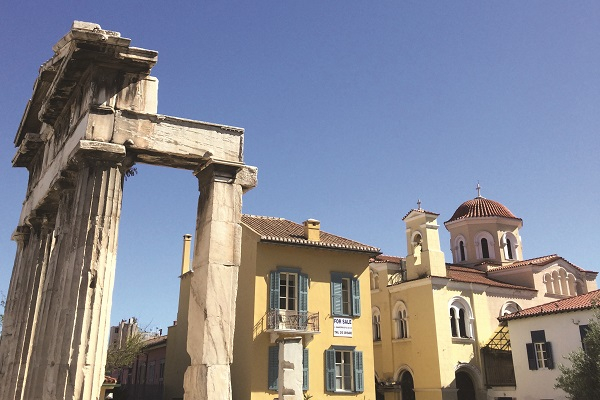
There are few places in the world where so many centuries coexist as naturally as they do in Athens. Here, ancient ruins, Byzantine churches, Ottoman influences and elegant nineteenth-century buildings all stand within walking distance of one another, creating a city that feels less like a museum and more like a living timeline.A walk through Athens is not simply sightseeing; it is a journey across different civilizations.
The story naturally begins with Ancient Greece. Above the city rises the Acropolis, crowned by the Parthenon, the great temple dedicated to the goddess Athena nearly 2.500 years ago. Around its slopes lie the remains of the Ancient Agora, where philosophers, politicians and ordinary citizens once gathered beneath the Attic sun. Even today, the worn marble paths and scattered columns preserve the atmosphere of a civilization that shaped philosophy, theater, democracy and Western thought itself.
Yet after the glory of classical Athens faded, the city entered another long and important chapter: the Byzantine era. For many visitors, Byzantine Athens is quieter and easier to miss, but it remains one of the city’s most beautiful layers. Hidden among busy streets and modern shops are small churches built between the 10th and 12th centuries, when Athens formed part of the Byzantine Empire.One of the most beloved examples is Panaghia Kapnikarea, standing unexpectedly in the middle of Ermou Str. Surrounded by modern crowds and storefronts, this small stone church feels like a fragment of another world. Its red tiles, faded icons and peaceful interior create a striking contrast with the busy city outside.
Another remarkable site is Little Metropolis, a tiny Byzantine church beside the Metropolitan Cathedral. Built with fragments of marble taken from ancient buildings, it perfectly reflects the way Athens constantly reuses and reshapes its own history. These churches reveal a different Athens, not the city of philosophers and temples, but a deeply religious medieval city filled with incense, candlelight and Orthodox tradition
Centuries later came Ottoman Athens. Though fewer traces remain today, visitors can still glimpse this era in neighborhoods like Plaka, where narrow streets, shaded courtyards and certain old houses preserve an Eastern atmosphere that survived from the centuries of Ottoman rule. Then came the 19th century and the birth of modern Greece. After independence from the Ottoman Empire, Athens was chosen as the capital of the new Greek state in 1834. At the time, it was still a relatively small town surrounded by ancient ruins. The newly established government dreamed of transforming it into a European capital worthy of its classical heritage. This vision shaped much of central Athens as we know it today.
Elegant neoclassical buildings soon appeared across the city, inspired by ancient Greek ideals but influenced by European architecture of the period. Some of the finest examples can still be admired along Panepistimiou Street, especially the famous Athenian Trilogy: the Academy of Athens, the National Library of Greece and the National and Kapodistrian University of Athens. With their marble columns, statues and grand staircases, these buildings reflect the young nation’s desire to reconnect modern Greece with its ancient past.
And still, Athens continued evolving. Today’s city blends all these eras together. Ancient ruins stand beside apartment buildings from the 1960s. Byzantine chapels hide beneath office towers. Neoclassical mansions share streets with graffiti-covered cafés and modern rooftop bars. That is the true magic of Athens: history here does not belong to one single period. The city carries every century at once. In a single afternoon, a visitor can move from the world of Socrates to the world of Byzantine monks, from Ottoman courtyards to the grand ambitions of modern Greece, all without ever leaving the same city.