

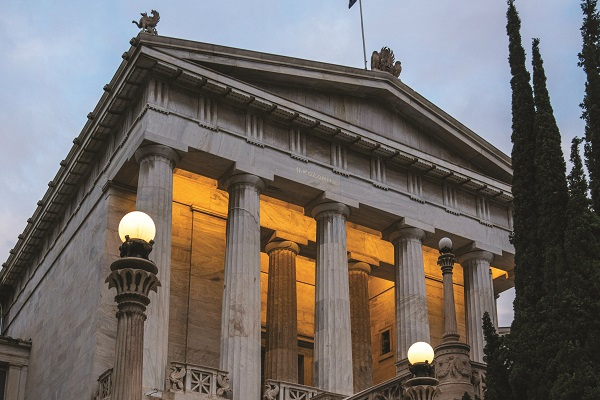
Photo by Jeffrey Zhang / Unsplash
By Georgia Skamaga
The Architectural afterlives of modern Athens
Beyond the city’s celebrated antiquities lies another Athens: a city of neoclassical residences and hidden architectural treasures. Behind elegant facades, wrought-iron balconies and fading frescoes, the old houses of Athens reveal a capital constantly reinventing itself. Some were built for archaeologists, merchants and aristocrats during the optimism of the 19th century. Others survived wars, political upheaval and rapid urbanization. Many no longer serve their original purpose. Today, these former private residences have become museums, parliament buildings, cultural institutions and living monuments to the city’s transformation.
The dream palace of Heinrich Schliemann
Among the most remarkable mansions in Athens is Iliou Melathron, the former residence of the German archaeologist Heinrich Schliemann, famous for excavating ancient Troy. Designed by the renowned architect Ernst Ziller in the late 19th century, the mansion embodied Schliemann’s fascination with the ancient world. Its lavish interiors featured frescoes inspired by mythology, mosaics, painted ceilings and symbols referencing Homeric legends. The building itself was conceived as a personal palace celebrating archaeology and classical civilization. Today, the mansion houses the Numismatic Museum of Athens. Walking through its halls, visitors encounter not only collections of coins and artifacts, but also the ambitions of an era when archaeology, nationalism and high society shaped the identity of modern Greece.
Aristocratic Athens in Kolonaki
Nearby stands the elegant Stathatos Mansion, another masterpiece designed by Ziller. Built for a wealthy Athenian family, the mansion reflects the refined cosmopolitan taste of late 19th century Athens. With its symmetrical neoclassical design, graceful balconies and decorative interiors, the residence recalls a period when the city’s elite sought to imitate the sophistication of European capitals. Today, however, the building serves a very different purpose: it forms part of the Museum of Cycladic Art. This transition from private mansion to public museum mirrors a wider story repeated throughout Athens. Buildings once reserved for aristocratic families now belong to the cultural life of the city. Their drawing rooms and salons have become galleries, lecture halls and exhibition spaces
From royal residence to Parliament
Νo building illustrates this transformation more clearly than the Old Royal Palace at Syntagma Square. Originally constructed as the residence of King Otto, the first monarch of modern Greece, the palace symbolized the creation of the new Greek state after independence. Designed with austere neoclassical lines, it stood at the center of a carefully planned capital intended to project authority. Today, the same building houses the Hellenic Parliament. Outside, tourists gather to watch the ceremonial changing of the guards. Yet behind the familiar spectacle lies a building that has witnessed nearly every major chapter of modern Greek history.
The romantic villa of the Duchess of Plaisance
Not all Athenian mansions were expressions of strict neoclassical order. Villa Ilissia, now home to the Byzantine and Christian Museum, reveals a more eccentric and romantic side of 19th century Athens. Originally built for Sophie de Marbois-Lebrun, the Duchess of Plaisance, the villa combined European romanticism with oriental influences. At the time, this area stood at the edge of the city, surrounded by countryside rather than dense urban development. The Duchess herself became a legendary figure in Athens society, wealthy, unconventional and fascinated by Greek culture. Her residence reflected both personal fantasy and aristocratic grandeur. While many surviving mansions belong to the 19th century, Benizelos Mansion offers a rare glimpse into an older Athens that existed before the modern capital emerged. Located in Plaka, the mansion dates back to the Ottoman period and remains one of the oldest surviving houses in the city. Its wooden interiors, enclosed courtyard and domestic architecture differ dramatically from the monumental neoclassical buildings that later defined Athens. The house reminds visitors that Athens was once an Ottoman provincial town long before it became a European capital. In a city often obsessed with antiquity and modernity, places like the Benizelos Mansion preserve the memory of the centuries in between. Built around 1860, the elegant mansion on Koumbari Street once served as the residence of the benefactor Panagis Charokopos, a figure tied to the philanthropic and civic spirit of 19th century Athens. In 1910, the property was acquired by Emmanouil Benakis, who commissioned its transformation into a refined urban residence, entrusting its redesign to the architect Anastasios Metaxas, a key representative of the Athenian architectural renewal of the period. Following Benakis’ death, his son, Antonis Benakis, would go on to make a gesture that reshaped the cultural landscape of modern Greece: he donated both the building and his family’s remarkable collections to the Greek state, leading to the foundation of the Benaki Museum. Today, the mansion stands as the nucleus of one of Athens’ most important cultural institutions. Its collections, numbering approximately 40,000 objects, trace the long arc of Greek history and artistic expression unfolding across centuries within the intimate framework of a historic Athenian residence. Standing at the intersection of Kanari and Akadimias Streets, the Deligiorgis Mansion, a two-storey residence in the eclectic style and among the early works of architect Ernst Ziller, was built in 1882 as the luxurious private home of Leonidas Deligiorgis, brother of the Greek Prime Minister Epaminondas Deligiorgis. Following his death and the subsequent financial difficulties faced by his heirs, the building eventually passed into the ownership of the Pension Fund for Civil Servants (M.T.P.Y.), marking the beginning of a long and varied institutional life. Over the decades, the mansion has been repeatedly repurposed, reflecting the shifting history of modern Athens. It served as accommodation for soldiers during the German Occupation, later housed the Anglo-Hellenic Service and went on to become home to Marietta Rialdi’s experimental theatre as well as the Greek Film Archive, each layer adding a distinct cultural imprint to its identity. After a major fire in 1996 and an extensive period of restoration, the building once again reemerged as a space for contemporary creativity, hosting a New York-based gallery before entering its most recent chapter in 2025 as the headquarters of the Hellenic Film & Audiovisual Center (EKKOMED), strengthening its role as a hub for cinema and audiovisual production in Athens works of architect Ernst Ziller, was built in 1882 as the luxurious private home of Leonidas Deligiorgis, brother of the Greek Prime Minister Epaminondas Deligiorgis. Following his death and the subsequent financial difficulties faced by his heirs, the building eventually passed into the ownership of the Pension Fund for Civil Servants (M.T.P.Y.), marking the beginning of a long and varied institutional life. Over the decades, the mansion has been repeatedly repurposed, reflecting the shifting history of modern Athens. It served as accommodation for soldiers during the German Occupation, later housed the Anglo-Hellenic Service and went on to become home to Marietta Rialdi’s experimental theatre as well as the Greek Film Archive, each layer adding a distinct cultural imprint to its identity. After a major fire in 1996 and an extensive period of restoration, the building once again reemerged as a space for contemporary creativity, hosting a New York-based gallery before entering its most recent chapter in 2025 as the headquarters of the Hellenic Film & Audiovisual Center (EKKOMED), strengthening its role as a hub for cinema and audiovisual production in Athens.
The city behind the facades
Many of Athens’ architectural treasures remain hidden in plain sight. In neighborhoods such as Kypseli and along Patision Street, elegant facades survive beside modern apartment blocks, abandoned storefronts and busy avenues. Some mansions have been carefully restored. Others stand forgotten, their shutters closed and paint fading beneath decades of pollution and urban pressure. Unlike cities where grandeur remained untouched, Athens reveals its history through layers of transformation. Old aristocratic residences became schools, embassies, offices, museums or apartment buildings. Entire neighborhoods changed social identity over the course of a century. This contrast is part of what makes Athens unique.