

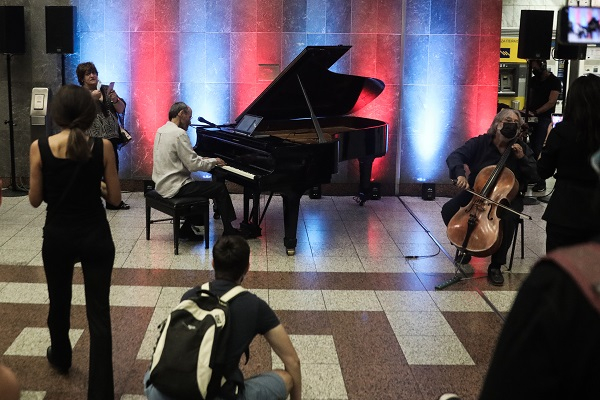
September 2021. A musical "farewell" to Mikis Theodorakis. Photo by Giannis Panagopoulos / Eurokinissi
By Victoria Shen*
Soon after arriving in Athens, I began to quickly notice fascinating aspects of the Greek lifestyle. For one, Greeks enjoy moments of spontaneity. After watching a spectacular Changing of the Guard ceremony at Syntagma Square, I carefully planned out my itinerary for the next two hours before my dinner plans. However, as I was running to catch the next metro, I got distracted by music that seemed to come from all directions. Curious, I looked around for potential loudspeakers but found instead a musician at a grand piano in the center of the station. I initially thought he was busking, but I soon realized that he was a passerby simply playing for the love of music. I managed to catch the end of his performance and was about to rush off, when another person unexpectedly stopped and took the piano bench. A cluster of listeners formed rapidly, and many of them began to hum the pianist’s melody. The metro station that I so often associated with the shuffling of feet and the clicking of ticket validation was filled with shouts of “bravo!” as people stopped to listen. Even more surprisingly to myself, I too stayed for another performance, and another, and another… until I checked my watch and realized I had been standing there for 90 minutes already. I thought to myself then, that, although it’s smart to travel with a plan, it’s a great stroke of luck to be pulled into the current of the impromptu thing just so happens to be happening
Perhaps born from this spontaneous environment, many Greeks seem to go about their lives with a love of doing things simply for their own sake or enjoyment. For instance, I was surprised to find the amount of time Greeks can spend nursing one cup of coffee. There is no such thing as table turnover, as waiters expect their customers to sit at their table for hours on end. Sometimes, I would leave my apartment to buy groceries and notice two or three people chatting at the local coffee shop. As I returned home an hour or two later, they would still be sitting there with the same coffee. Born and raised in New York City, I was previously only familiar with a graband-go culture where nobody could afford the time to sit down and relax. Here, I admire how free-spirited and easygoing Athenians seem to be. They aren’t lazying around in the slightest – they just enjoy what a slower pace of life can offer.
As an extension of this quality, Greeks don’t view anything from a goal-oriented, constantly forwarddriving mindset of nickel-and-diming. At traditional tavernas or less tourist-heavy restaurants in Athens, waiters have often brought me and my friends a free dessert after we’ve paid the bill. Appearing like magic at the end of a meal along with a smile from the waiter, these complimentary treats –apple slices sprinkled with cinnamon, waffles drenched in chocolate, or even an entire slice of orange cake– seem to be common practice in the city and a great example of abundant Greek hospitality.
Greeks seem to have a mentalityof encompassment even in terms of their physical environment. After roaming around for a few days, I observed a principal difference between Athens and Manhattan. While Manhattan is known for its neverending construction of cloud piercing skyscrapers and mindset of perpetual advancement –be it structural or technological or both– Athens has archaeological protection laws that limit the height of the city’s buildings to ensure that no modern architecture is tall enough to block the view of the Acropolis. With an active appreciation for preexisting archaeological sites, Athens remains very in touch with its surrounding environment. Contemporary houses never impede upon what is already there – whether it be a church, historic building, or a couple of ancient columns. Quickly, I’ve learned to appreciate the preservation of Old Athens as New Athens is being simultaneously built.
In addition, there is a relationship between Athenians and wild animals that does not exist between New Yorkers and non-domesticated animals. For one, the massive stray cat population in Greece does not impinge upon daily living. Rather, it is customary to care for these animals: I often see people sitting in green spaces like the National Garden for hours on end to feed these animals. There are also frequently cardboard signs lying around in public to encourage passersby to donate water; I have rarely seen an empty water bowl. Recently, a couple of birds took a rest on the chair across from me at a cafe. Nearby, two more landed on another table, and I watched the local affectionately coo at them and offer slices of pita from his meal. There was no feeling of fear or disruption from both parties, which was quite heartwarming to see, given that most New Yorkers view pigeons as nuisance and try to swat them away. Whereas New Yorkers often only coexist with their natural surroundings, Athenians seem to engage in a relationship extending beyond a simple symbiosis.

* Victoria Shen is a Princeton University student from China, doing a summer internship in Athens.