

by Tania Skrapaliori
Some places are forever framed in your mind by the circumstances under which you first discovered them. And when you return, the true challenge is to see whether both memory and reality have withstood the test of time. Salamina is one such place -the largest island in the Saronic Gulf, so close to Piraeus that many don’t even consider it a true island. But an island means taking a boat, however briefly, into open waters- even a short distance from Athens is enough to make you feel like you've broken free from the city’s frenzy.
So near, just a few minutes away by ferry or traditional boat from Perama to Paloukia, Salamina greets you with a new town that looks almost identical to any Athenian neighbourhood. Its thousands of permanent residents commute daily to the capital, which often prevents it from fitting the typical “island utopia” stereotype we hold for summer getaways. Yet somehow, Salamina offers its own idyllic setting -summer as it was in another era, frozen in time, preserved through the memories of generations.
With 37,000 residents and a rich history, Salamina -also known as Koulouri, homeland of King Ajax, the tragic poet Euripides, and the poet Angelos Sikelianos- is full of beauty and interest for the modern urban explorer. Its strategic location made it crucial to Greece’s military history -from the Persian Wars and the legendary Battle of Salamis to the Greek War of Independence, when it served as a refugee hub and hospital center. History lives in every corner, seamlessly woven into the landscape.
There’s the Mycenaean acropolis at Kanakia, home to Ajax’s ancient palace; the Cave of Euripides at Peristeria, a Neolithic sanctuary that became the tragic poet’s retreat, now offering hikers a magical view of pine forest and sea. The coastal Faneromeni Forest, home to the historic 17th-century monastery founded by Saint Lavrentios and used as a revolutionary base in 1821, with its shaded coves and the all-white house of Angelos and Anna Sikelianos in view. There’s also the burial monument at Kolones, and to the south, at Lykopoulo Bay, the stone-built Konhi Lighthouse -among the most beautiful in Greece- standing proudly since the early 20th century, once a noble guide for ships, now a favorite of Instagram photographers, watching over countless sunsets.
But beyond its official history, Salamina tells another story: one written by those who made it their summer refuge long before the age of Instagrammable island-hopping. This is the story told by its neighbourhoods -dotted with small, whitewashed homes built in the '70s and '80s by working-class families, coexisting with the more elaborate summer homes of middle-class officials from the same decades, distinguished by quirky gypsum decorations: ducks, garden gnomes, dry fountains. Both house styles are united by lemon trees in the yard, flowers draping over walls, and narrow dirt paths leading to the main road.
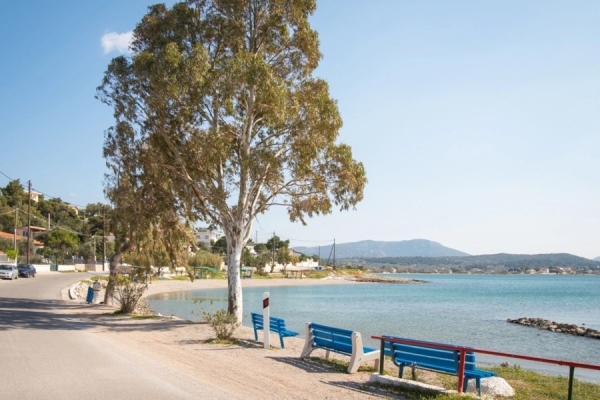
This harmony is occasionally disrupted by modern “villas,” with tall fences and security cameras, claiming every inch of land -signs of the times. Yet this summer narrative continues at the beaches, the lesser-known coves, and their more popular sisters: the organized Selinia beach, family-friendly Psili Ammos, secluded gems like Peristeria, Saterli, and Kaki Vigla, and the peaceful, local-favorite Perani. Beaches brimming with childhood memories: hours-long swims, returning home to grandma’s meatballs, fries, salad -and a stop at the bakery for platetsi, the local olive oil bread.
And then it rests in the siesta, in afternoon reading on patios, and reawakens with energy after sunset: for strolls along Karaiskaki Coast, ouzo and octopus at Karnagio or one of the island’s many authentic tavernas, souvlaki at Krinos, and loukoumades from street vendors. And as the day winds down, the narrative takes another turn -it lingers among the pines, ready to begin again, unchanged, like true summer days, open to new adventures.
The magic of Salamina lies in its ability to keep these summers alive. Often misunderstood, Salamina is still -and always- right there, just a breath from the port of the frantic city, holding treasures for those willing to search. Stuck in the summer hour of our childhoods, full of analog postcards from another time, when summer was as simple as a family eating olive oil bread and fruits under a pine tree by the sea.