

By Stavroyla Panagiotaki, Yannis Nenes
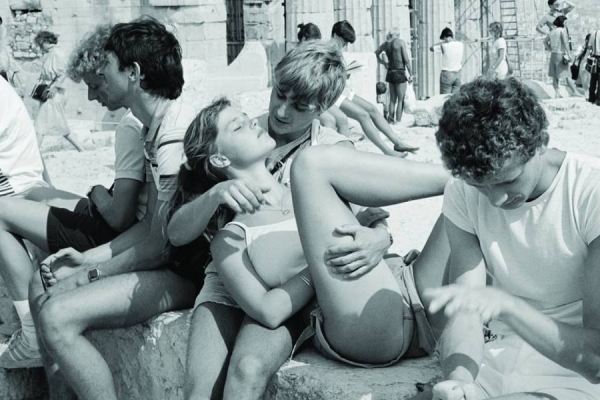
During the summers of 1983 and 1984, American photographer Tod Papageorge, whose roots trace back to the land of Messinia, captured the Acropolis and its visitors like no one else. At the time a professor of photography at Yale University School of Art, he climbed the sacred rock daily, turning the ascent into a kind of ritual. There, he set up his camera and immortalized moments unique and fleeting. The young tourists, sandals on their feet, dressed in light summer clothes, sometimes tired or bored beneath the Parthenon’s grandeur, blend effortlessly into his frames. Papageorge’s photographs brim with nostalgia, desire and sensuality, perhaps the most intimate, enchanting portrait of the Acropolis and its visitors ever made. He recalls this experience in an interview with ATHENS VOICE, upon the release of his book “On the Acropolis”
(Stanley/Barker)...
“I first visited the Acropolis one afternoon in 1979 , a brief introduction, but enough to call me back. I returned and stayed for a whole month during the summers of 1983 and 1984 at the Divani Zafolia Hotel. Ten minutes’ walk took me through the Propylaea to the Part henon. For those two months, this walk was my ritual, usually twice a day, after breakfast and after lunch. I often ate at a vegetarian restaurant down a sloping lane in Plaka and spent the rest of the day photographing. I think it was a natural feeling that drew me. I loved the challenge of working in a space the size of several football fields, a space visually composed of white rock and nothing else. But atop that rock stood the ‘bare bones’ of three magnificent temples. I put myself to another test, using a relatively heavy and awkward medium-format camera. A camera I hoped would ‘capture’ the harsh beauty of the brilliant Attic light, rather than a Leica with its nimble response that I could easily maneuver.
I studied literature and wrote poetry in college. The way I understand things is from the perspective of one who ‘reads’ the natural world as emblematic, full of meaning, a meaning the camera, if wisely used, can capture.You could say the people, young or old, in my photographs and only there, play a larger and more significant role than that of mere tourists on the Acropolis. Their path up to the Parthenon echoes the journey ancient Athenians once took. But mostly, their movements, their gestures, even the simple summer clothes they wear, bring before my eyes the stories and myths that formed the foundation of Western tradition and culture. I don’t say that everyone who sees my photos will find the same meanings, but this is my reason for taking them”.
That August, when we arrived, the island seemed to be holding its breath, dazed by the sun, adrift in a sea that simmered in peacock blue beneath a sky faded to a hazy, pale azure from the sheer force of the sun’s relentless glare
- Gerald Durrell
“The Corfu Trilogy”, 2006)
Sophia Loren, Parthenon 1956
September, 1956. Sophia Loren, 22 years old and already a luminous star, stands at the Parthenon, eating a simple meal of bread and cheese, a scene from “Boy on a Dolphin”, where she plays a young islander from Hydra.
Her arrival in Athens was an event of mythic proportion. Crowds flooded the airport, so thick and fervent that the police had to intervene to restore order. Loren stayed at the Hotel Grande Bretagne, in Suite 256, always filled with her beloved pink roses. It was there, in the heart of the city, that she celebrated her birthday on September 20.
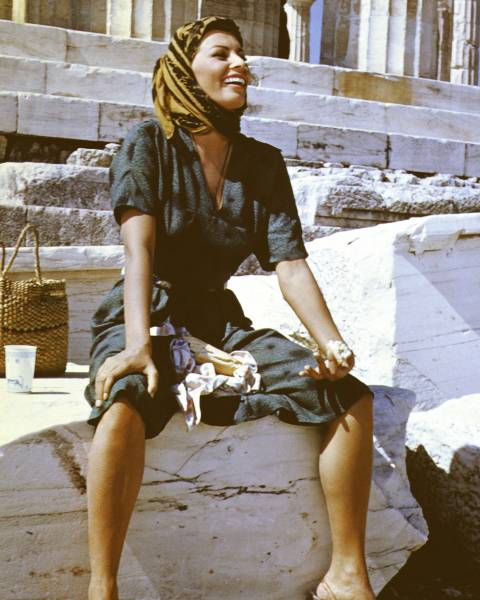
She remained on Hydra for 39 days. Filming also took her across Greece, through the marbles of the Acropolis, to the Tomb of the Unknown Soldier, to Glyfada, to the port of Piraeus, where she appeared alongside Alexis Minotis, to the ancient theatre of Epidaurus and finally to the sacred heights of Meteora, where she stayed a week among rocks and silence. For her role, the star was taught Greek dances by Yiannis Fleury. In the film, she sings with Takis Morakis the now-beloved song “What is this thing they call love?” and a triumph it was. This was the first Hollywood production shot in Greece in the grand, sweeping format of CinemaScope 55.
David Bowie, Patmos 1985
Bowie’s deep affection for Greece took root in Cyprus, where his first wife, Angie, was born and raised in Nicosia by American parents. In May of 1975, he slipped quietly into Greece, incognito, with Iggy Pop at his side. The two wandered through the sacred ruins and sun-drenched stones of Delphi, Sounion, the Acropolis, guided by Yiannis Petridis. In Athens, they roamed freely, blending into the city’s rhythm, unrecognized. During the golden summers of 1985 and 1986, Bowie found refuge on Patmos, a guest at the lavish home of Prince Aga Khan IV.
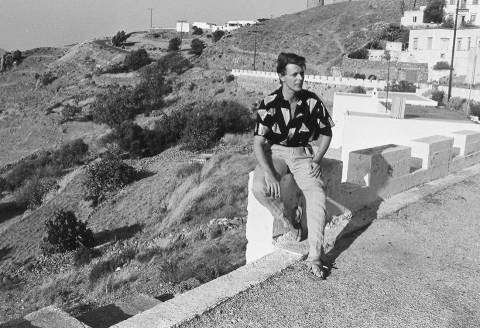
There, he wandered undisturbed along remote beaches, through quiet shops, under the Aegean light. Whispers floated through the island’s narrow lanes, suggesting he had bought a house on this isle of revelation, but they were just myths. By night, he favored Astivi, a small, atmospheric bar, the only one permitted to open in Chora, under the watchful eye of the monastery. And in the summer of 1988, the wind carried him further still, to the island of Ios.
In darker moments, I see one solitary cove after another and one island after the next, as they are now and as they may become... The coastline girdled with fifty jukeboxes and a thousand transistor radios. Every house turned into an “artistic” bar, a boutique or a shop of sundries – new hotels rising, concrete villas multiplying.
- Patrick Leigh Fermor
“Roumeli”, 1956
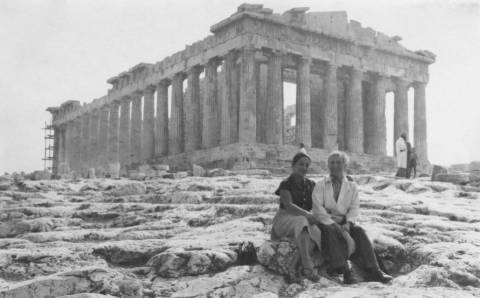
Marc and Valentina Chagall, Parthenon 1952-1954
In the early 50s, Marc Chagall accepted the challenge from his close friend and publisher, Tériade, to illustrate Daphnis and Chloe, a romantic, bucolic prose set on the Greek island of Lesbos. To truly understand the world and spirit of the story, Chagall traveled to Greece twice: first in 1952, when he was guided through Athens by Odysseas Elytis, and again in 1954.Beyond the capital and the Acropolis, he explored Delphi, Ancient Olympia, Nafplio and naturally, Poros. On this picturesque islet of the Argosaronic Gulf, he stayed at the Galini villa, on the shore of Perlia Bay, for five summer days in ’52 and another five in autumn ’54. Every place unveiled a revelation – a world brimming with secrets at every step.
…In Crete, I truly understood what the night sky means. With its giant stars, its full-moon nights, its inky blackness and the constellations that here bear names of their own: the Pleiades called Pouliá, the Big Dipper known as the Upside-Down Boat, the Milky Way Jordan River. What struck me most was this living sky, so close, so vivid, I had forgotten it existed. Each night, I discovered it anew, as if for the first time, alongside the scents and the silent presence of the earth. During the early months of that journey, I spent nearly every night outdoors, sleeping on beaches, rooftops, threshing floors. Rarely since have I felt, as I did in those years, that sweet intoxication of absolute freedom, the joy of being a happy wanderer, bound to nothing but a village, or the face that might welcome you for a single night…
- Jacques Lacarrière The Greek Summer, 1975
I remember Marianne and I were in a hotel in Piraeus, some cheap hotel. We were both around twenty-five and had to catch the boat to Hydra. We got up, I think we had a cup of coffee or something, then took a taxi and I never forgot that moment. Nothing happened, we were just sitting in the back of the taxi with Marianne, lighting a cigarette, a Greek cigarette with that rich, deep flavor of Turkish tobacco, and I thought, I have my own life now, I’m an adult, I’m with this beautiful woman, we have a few coins in our pockets, we’re heading back to Hydra, passing those colorful walls. That feeling, I’ve tried to recreate it hundreds of times, but never quite succeeded. Just that feeling of being grown-up, with some beautiful woman you’re glad to be beside, and the whole world ahead of you… right ahead. Your skin sun-kissed, ready to board a boat. That’s a feeling I remember very, very well.
- Kari Estmar
“So Long, Marianne: A Love Story”, 2014