

by Katerina Kamposou
Imagine the city a few decades ago: no metro, no mobile phones, no Internet. Omonia Square was a well-kept, dazzling hub that gathered much of the capital’s commercial life. Elegant shops, family-run businesses, and hundreds of street vendors gave character to the city’s busiest streets — Athinas, Aiolou, and Stadiou, all the way to Syntagma. Up until the 1980s, these vendors lined the sidewalks: the greengrocer, the egg seller, the sponge seller, the “paneritzis” with his bread rings, the peanut seller, the chestnut roaster and the salep vendor in winter — the ice cream man in summer. There were also men with trays of warm cheese pies, shoeshiners lined up along Amalias Avenue, and hawkers selling “pistachios to pass the time” outside the old cinemas.
The last open-air fruit sellers of Athens
At some point, all these people packed up their carts for the last time, earned their final few drachmas, and took with them the memories of an entire era. Supermarkets began offering everything under one roof, the once-vibrant Chafteia district declined, and the Ermou shopping area took over — where today only a few bread-ring vendors remain. Yet for the past 40 years, two of the city’s last licensed fruit sellers have refused to disappear.
One of them is Thanasis Petrekas, known as “the last of the Mohicans.” Standing at the corner of Aiolou and Stadiou for four decades, he starts every morning by ringing the traditional brass bells hanging among his bananas to attract customers — mostly tourists these days, along with a few elderly Athenians who’ve known him for years.
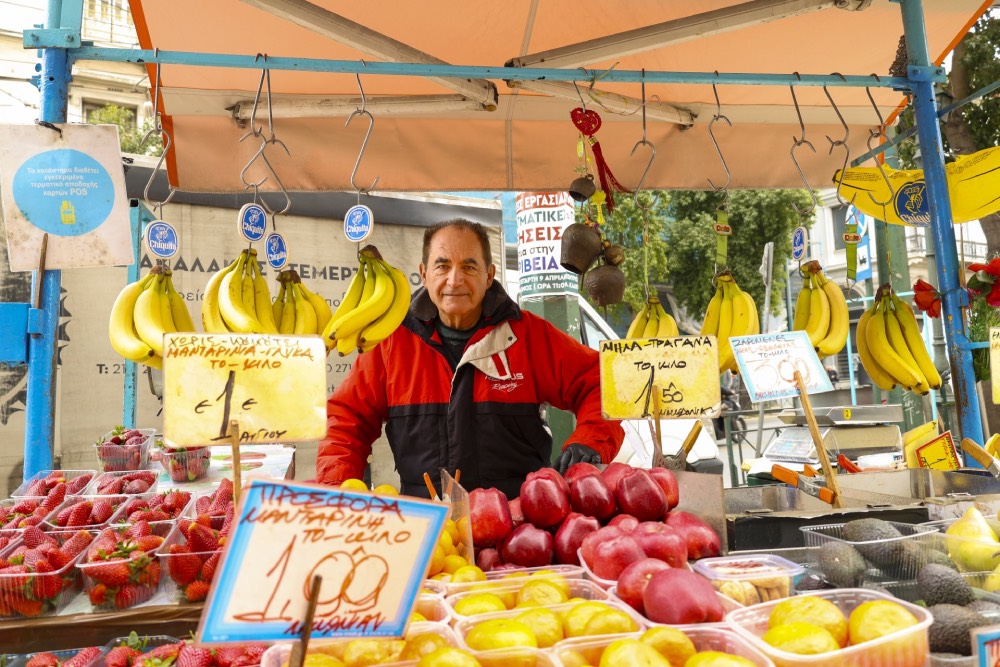
“When I was young, I was rebellious,” he says with a smile. “They kept firing me from every factory job I found. I didn’t have a degree, so my father — an old greengrocer — told me, ‘You’ll never make progress like this. Become a street vendor. That way, no one can fire you.’”
What was Athens like when you started? I ask.
“It was a pleasant city, cleaner, with more job opportunities. People were more honest, more polite. Do you see anyone smiling in the streets today? I wish we could go back. In the 1980s, there were about 150 licensed street fruit vendors in Athens — now there are only three.”
Why so few?
“It’s a tough job,” he says. “You wake up at five in the morning and finish around eight at night. If it rains, you get soaked. If it’s freezing or there’s a heatwave, you stay anyway until you sell everything. Young people can’t take this kind of work. Even my daughter prefers a job that pays 3 euros an hour instead of doing what I do, even though she’d make more money. My family admires me because they know they couldn’t handle it themselves. My wife has accepted it, and I do my best to provide for them.”
“You have to be sharp to make a living,” he continues. “And you need to keep your eyes open — not 14, but 44 of them — because there are always people ready to distract you and steal your phone or your cash machine. I could write a whole book about life on the pavement. I’ve seen everything! Once, the artist Alekos Fassianos came by, bought fruit, and even drew a sketch on one of my paper bags. I’ve also served Anna Vissi, former prime minister Konstantinos Mitsotakis, Mikis Theodorakis, Tolis Voskopoulos, and many others I probably didn’t even recognize.”
Greeks buy the cheapest fruit
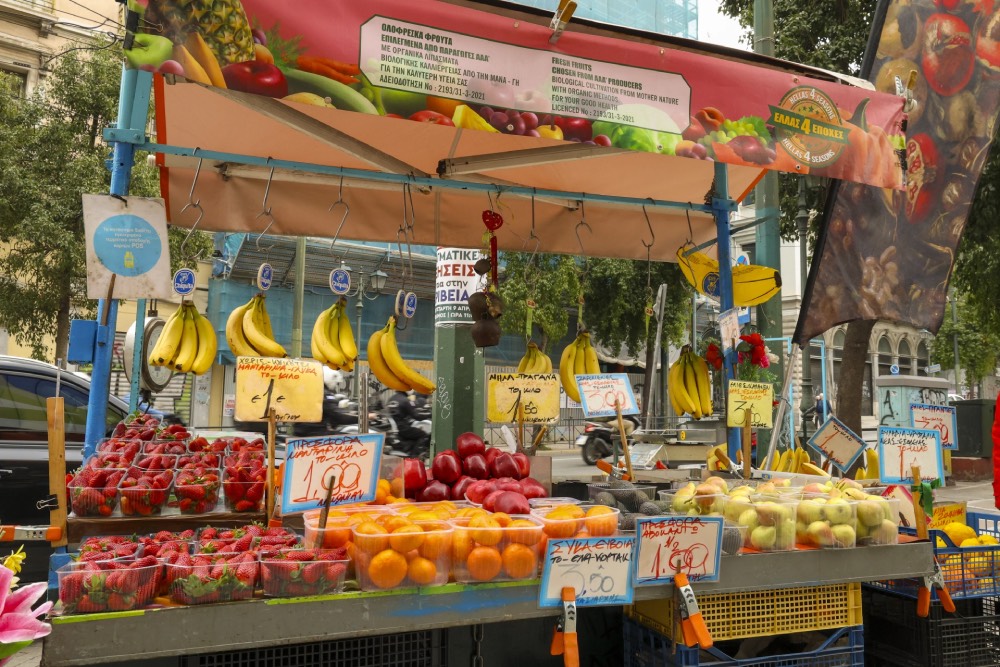
These days, Petrekas’ cart is loaded with fragrant mandarins, apples, avocados, pears, dried figs, bananas, tomatoes, lemons, and olives — all from Greek farmers. “I only bring seasonal produce,” he explains, “so that office workers can eat healthy food without chemicals or unnecessary fats. Next month I’ll have loquats and apricots, and in summer cherries and fresh figs.”
What’s the most popular fruit among Greeks?
“The cheapest one,” he laughs. “People can’t afford much. I sell clementines for one euro, strawberries for two, apples or pears for one and a half, tomatoes for one, olives for three and a half — prices you won’t even find at the open-air markets. Tourists, though, buy more — small quantities of many different fruits. They love apricots and cherries, which are expensive and tasteless abroad. In Germany, for instance, cherries cost four euros a kilo; I sell them for two.”
He adds with a note of nostalgia: “I urge Greeks to buy from street vendors, like their fathers and grandfathers once did. We offer quality and value.”
The red strawberries of Monastiraki
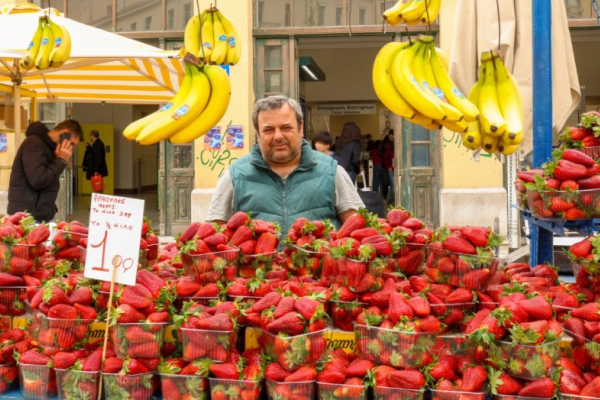
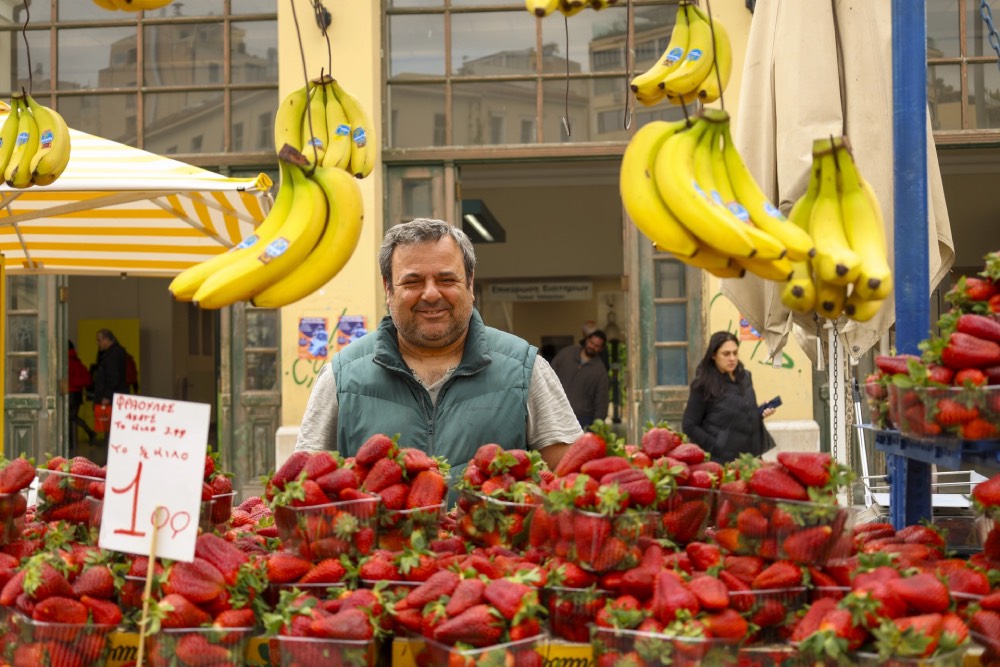
A few streets away, Filippas Liakas sets up his cart in front of Ifaistou Market in Monastiraki, right outside the metro station. At six every morning, he arranges his strawberries, oranges, apples, bananas, grapes, and kiwis. His father first claimed that spot in 1976; today, Liakas continues the family tradition and is now teaching the trade to his 19-year-old son.
“Everyone comes for the strawberries — they catch people’s eye, especially the tourists,” he says. “When I started, Monastiraki wasn’t this touristic. There used to be a flea market here every Sunday, with carts filling the square. One of my regulars back then was Daniel Batista Lima, the AEK football legend.”
What does he love about the job?
“It’s taught me patience,” he explains. “Sometimes people take out their frustrations on you over a single strawberry that doesn’t look perfect. You meet all kinds. But I love what I do — it helps me earn my bread, and you have to respect what feeds you. On the other hand, the earnings are just enough to survive. This job doesn’t really pay — it’s all hard lifting and long hours because the square is always busy.”
Does the noise and the crowd ever get to him?
“That depends on you,” he smiles. “If you look at people positively, they’ll see you the same way.”
Maybe the profession of the street fruit seller isn’t truly disappearing after all. It lives on in the stories of old Athenians, in black-and-white photographs, and in the scents of a time that may never return — but will never be forgotten either.