


by Theodore Kim
I had found Maggie through her Workaway profile. Her profile was a brief but intriguing description of a single mom living with her two kids in a small Naxos village, surrounded by mountains and sea who runs marble carving workshops and starting a permaculture project. My parents were a little alarmed when I told them I was going to stay with a stranger I’d met online, let alone on an island that I’d never been to, but I figured if I got kidnapped and survived it would’ve made for an interesting story.
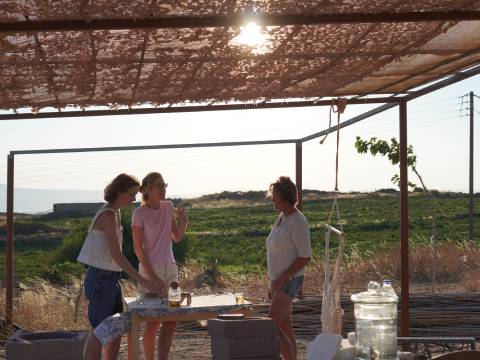
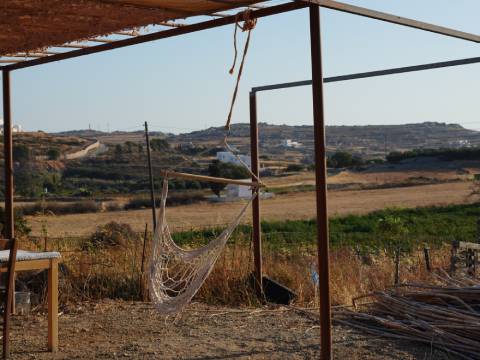
Maggie’s farm felt like a place out of a postcard. On one side rolling hills, the Zas mountain and unkept wildflowers that breathed in the cycladic wind in a way that felt biblical. On the other, the ocean and the fiery red eye that is the sun that slowly rolled down the sky as it overlooked the marble carving course that Maggie tended to. The farm was built in the 80s and on it stood the lone μιτατος that once housed goats. Goats were then replaced by Maggie’s farming equipment and her own makeshift pantry filled with Naxos-grown wine and cheese. Maggie herself moved from the United States to the Cycladic island of Tinos in 2008, then to Naxos in 2010, and found this latest farm just last summer looking for somewhere specifically “with a mountain or sea view.” Maggie’s marble workshop stood alone in the center of the property—a structure of poles of reed wrapped in windbreak and bits of marble scattered on the soil around the workstations made of concrete blocks. On the ground next to it lay a bed of sleeping reed stakes waiting to be used for future projects, and scattered about the farm were her own works of marble that could’ve been in a museum. We fed the chickens in the coop in the back corner while she told me about the other projects she planned on making in the future: medicinal herbs, a geodesic dome, a food forest. “Not much more, [just] the evolution of making it more beautified,” she said.
Despite the farm's raw amalgamation of different textures, Maggie placed everything with care and consideration. Being there on her farm it felt like I was witnessing the birth of something beautiful: when land is uncultivated and untouched and gaily searching for loving hands to tend to it. Before we left she threw a handful of olives on the ground; apparently one of the smaller chickens knows an escape route from the pen so they leave little snacks for her to find.
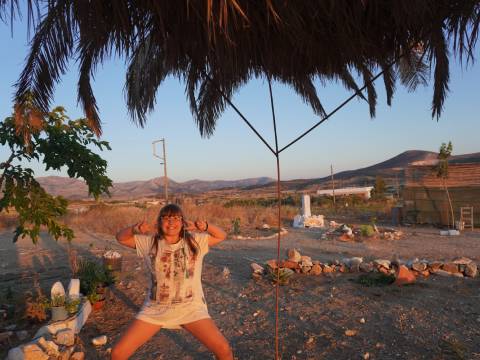
Maggie's second child and only daughter, Fedra, absolutely stole the show. She is just ten years old and celebrated her “half birthday” during my stay (which she made sure to remind me of many times). She was eager to show how many marble pieces she’s made, and even challenged me to a carving competition which, I hate to admit, she won quite easily. Fedra was unafraid to speak whatever was on her mind, and throughout my stay she narrated her world: the best beaches around Naxos, the new “Labubu” craze and her favorite Taylor Swift songs, the time she sprained her ankle and had to be in a cast for three months (which Maggie later clarified was two days), and the most pressing concern in her life that no one “older” could ever possibly understand: fifth grade.
Along with Morpheas, Maggie’s eldest son, both Fedra and he proved that creativity is an inherited gene. Every day was some new DIY project, the home’s soundtrack being loud banging and drilling that made its way through the outdoor corridors of the old white-plastered home they shared. Maggie bought the house from a family who had lived there for generations, a charming place parked in Glinado with thick stone walls and cats that wandered in and out of the courtyard that were welcomed into her home like long lost family. Morpheus and Fedra would fight over who got to use the drill, teasing and screaming that took a brief hiatus when Fedra made fruit smoothies, which we drank together under the lone tree in the courtyard. The house was unapologetically theirs, and they got to paint it with the hues of their love.
On the second night we ran into Maggie’s friend and neighbor, Lou, at the local Taverna. We found him eating on his own accompanied only by a stray black cat that claimed the seat across from him. Lou was also an artist who mostly worked on clay pieces, one of which was hanging just behind us in the restaurant. He told stories of growing up in Bar Harbor, Maine, memories in his family restaurant, walking through the meat locker and seeing the special cuts reserved just for his father. One thing that Lou had mentioned was his admiration and longing for the way Naxos used to be. He eagerly showed me photos of Naxos from when he first arrived over thirty years before and reminisced on the days before everything was a hotel. When the land felt untouched and raw.
As Naxos has built up its tourism industry over time—like many of the other Greek islands—its local economy has changed, and so has the island’s spirit. Maggie describes the influx of “boutique hotels, more swimming pools, more building, building, building. We have changed. There's definitely been a drastic change since 15 years ago when I first came.” When I asked how the locals felt about it, she said, “well, everyone's complaining about it. And of course what will become of the island.” The question arises: How do you keep a culture when so much is changing? How do you remain authentic when everything’s commercialized? I see countless Anti-Tourist Protests around Athens. In any place with high tourism there’s a sentiment of “losing culture” with growing tourism. What does it really mean to be a local, but does that even matter? If you truly love and care for a place, to contribute and immerse yourself into it in a way that doesn’t detract from what is but to help it grow, that’s how a community evolves. Maggie herself isn’t Greek, but she made an effort to understand and adopt the Greek culture, to learn the language and to be a part of the community. The metamorphosis of a place, like with any art piece, is not linear. As Maggie describes her experience with marble carving, “things are going to break. Things are going to destroy. Yeah, this is part of the learning process so every once in a while there's somebody that it really hits them to the core. It makes them think something different, but I'm always trying to like, bring that in a positive way.” As time goes on, culture is bound to change. The more it does, the stronger the Naxos identity becomes. The more you chip away at the marble the more beautiful the piece.
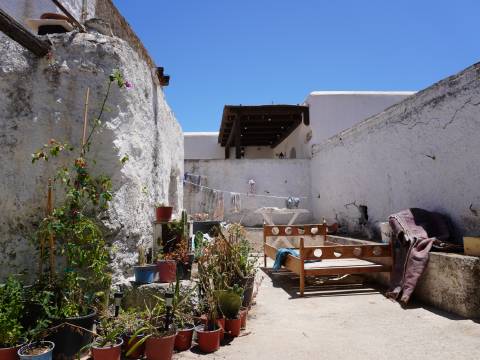
Naxos feels like a place where everything grows—a place cared for by the hands of the people that live it. In Maggie's home I was surrounded by different succulents and herbs growing in flower pots, projects being done every day to improve the home little by little. The food we had was fresh and local. The wine we were served in glass pitchers was always somehow grown “just down the street.” The eggs we ate came from the chickens that Maggie and Fedra bought from a truck driving around Naxos selling them by the call of a loudspeaker. The new mattresses Maggie ordered were stained with the smell of cigarettes from the chainsmoking of the man who wove it himself. Everything was grown and baked with the scent of Naxos, a core defined by the spirit of the people who live in it.
As time goes on there will, of course, be resistance and disdain for the direction Naxos goes as things change. People for whom “it really hits them to the core.” Memories of what once was gets colored in a bittersweet nostalgia that makes it difficult to usher in what is and what could be. But with time the edges soften, a new identity germinates, and memories are formed to start the cycle all over again. A cyclical nature. At one point during our conversation Lou said, “memory is the second thing to go.” Maggie smiled and asked, “What’s the first?”
“I forget.”
When I asked Maggie if she saw herself retiring here, she shrugged and told me she didn’t know. “As long as it feels right, I will continue,” she said. Maggie doesn’t want to be completely attached to a place or what she’s doing because things can change. In the same way that she never would’ve expected living in Greece when she was growing up in Indiana, who knows where the future will take her. Everything is constantly growing, changing, alive. What won’t change, however, is the unwavering love that she has for her family, for Fedra and Morphaeus. What she does want out of her future is to “be alive when the kids are in their 40s… to be there for them in the future and to see them grow up and what they're doing.”
Below I’ve taken transcribed excerpts from our conversation we held at her farm. We sipped rosé and talked for hours overlooking everything in her farm that was and imagining everything that would be until we said goodbye to that same fiery red eye that winked through a cloud as it finally set on the Naxos horizon, one sight that’ll never change.
Conversation with Maggie
Theo: The way I start off with these is always the same question, which is who are you and what do you do? Which is purposefully vague.
Maggie: Yeah, personally vague. How do we define ourselves?
Theo: It's up to you.
Maggie: I was just thinking about this the other day. Do we define ourselves by what we do? Or do we define ourselves how we do things? It's a question for everybody because it's something I struggle with... But anyway, yeah, who am I? Where do I come from? Why am I here? It's a loaded question. So where do we want to start with that? How I ended up here?
Theo: Alright, okay, actually let me just take a step back then. Where are we? That's a good question.
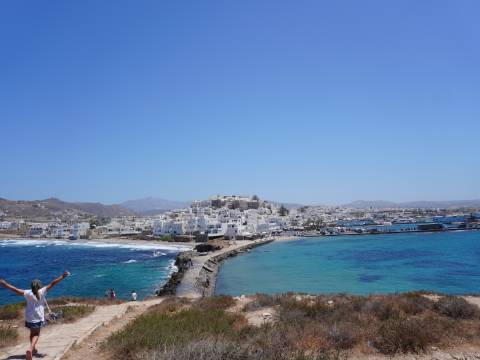
Maggie: Okay, well we're in Naxos, Greece, on an island. On this amazing place that I took me a while to find, but between the mountains, the Zas mountains, and between the sea. So it's this, the farm landscape, but I have this expansion of this open view, which is really what I envisioned actually to find at some point.
Theo: And you got this place recently.
Maggie: Just last summer, yeah. Last May.
Theo: And what does this place mean to you? It feels like it's very close to your home as well.
Maggie: Yeah, it's a blank slate. There was nothing here. There was only a field, these buildings back here, and some goats. So it was like a blank slate to start something new and to completely have my creative freedom to make the garden, to make the space, make all these things.
Theo: I feel like being here, in the way I'd like to feel about going to Greek islands, because obviously now everything's so touristy… Lou was talking about yesterday how different islands used to be, before the tourists took over. They were so pure and still being built. And that's kind of how I feel coming here. You talk about all the projects you're going to make, and it feels like I'm here at the beginning of that. And I get to see the evolution of it which is cool.
Maggie: Yeah. Yeah.
Theo: Do you have any kind of vision of what you see this whole space becoming eventually?
Maggie: Well not much more, just the evolution of making it more beautified. Of course, the gardening, the trees. I wanna make a food forest. I wanna have the medicinal herbs. Basically the structures, there's only one more structure that I want to make.
Theo: Which is?
Maggie: Which is a dome.
Theo: A dome.
Maggie: A dome.
Theo: Like a greenhouse dome?
Maggie: Like they have these, like a geodesic dome. And there's another one called, I can't remember the name of it, but it has more of a spiraling pointy top to it. I found this new design. Anyway, this is gonna go down at the end here. I just want to make a space that if somebody wants to come and do like even a yoga class, meditation, music. Plus in the winter time, we're struggling to find spaces. You know, because I have friends, we do a yoga class, we wanna do a dance class or something like this. And we're struggling to find space to do that so I want to provide that.
Theo: That is all encompassing.
Theo: What brought you here to Naxos specifically? Because you're not Greek.
Maggie: Yeah, I'm not Greek.
Theo: So what was that story like?
Maggie: That's a big story.
Theo: Is that a big story? Well, we have plenty of time.
Maggie: The first time I came to Greece was in 2008. I had it super focused: “I'm going to do a one month workshop on marble on Tinos Island.” So I went to Tinos originally. I was supposed to stay for one month and do this workshop, and the piece that I did is her right here. I had a great master and he was in his late 70s and because I wanted to learn specific techniques which I couldn't find in university or I couldn't find workshops and things in the States because I started with limestone and any stone carver I came across was just like, you know, free-forming it. But I knew that they had these techniques that existed so I found this workshop in Tinos. I stayed for three months, and then after the three months, I fell in love with the scenery and the island life, and I wanted to learn the language, and had all these ideas, so I came back the next spring.
Theo: Yeah.
Maggie: What I thought was gonna be two years.
Theo: Spring 2009.
Maggie: Yeah, spring 2009.
Theo: When you first came here to Naxos, was 2009?
Maggie: No, I went back to Tinos actually. It was Tinos for a year. For a year and a half, almost two years. So 2008 to 2010.
Theo: What was it like moving to Greece for the first time? Was that like a crazy culture shock, getting used to it?
Maggie: I loved it. I guess I was thirsty to explore something different, culture, different language. And I don't know, I wanted some sort of adventure, you know, so I said I'm gonna go back for two years. This was my plan. I go back to Greece for two years, do some sculpting, and work in the studio. I found a studio to work in. I was working in a taverna just to get by.
Theo: Without speaking Greek.
Maggie: Without speaking Greek at that time.
Theo: Yeah. You get by doing that? Working in a taverna, you get thrown into the fire.
Maggie: Yeah, yeah. That's immersive learning.
Theo: That's how I learn.
Maggie: So after a year and a half of literally wandering around, I needed to leave Tinos and I said, "oh, I'm just gonna go to Santorini, I'm gonna go to Naxos because Naxos has the big history of the marble here. Yeah, and I want to see what this island is doing and it's a bigger island anyway." I guess I was finding excuses not to go back.
Theo: to the US?
Maggie: To the US, yeah.
Theo: You mentioned that your life in the US and your life here kind of feels like two completely different timelines.
Maggie: It's like almost a past life.
Theo: Yeah, and what does that feel like? Do you ever miss being there?
Maggie: I miss the most of it. I miss my family. I have a brother and my parents are still there, and I have friends, very good friends. So I miss them and I don't get to see them or be able to travel back and forth. It's been a little bit of a struggle with that.
Theo: But I think that kind of change in your life, a major shift from not even just one place to another, but then also, you know, starting a family in a completely new country and everything. Almost the point where it's like—
Maggie: a different life, like completely.
Theo: Yeah, like the memories back then, do they have a completely different color and everything?
Maggie: Of course, of course. Yeah, I think back, you know, talking about playing music in Austin, Texas. Well, my kids don't believe me!
Theo: (laughs) Actually that's one of the questions I have as well. So you were in a rock band. I guess in my head, you are living here on an island in Greece, doing a marble carving workshop. Permaculture, everything. And then on the complete opposite end, playing in a rock band in college.
Maggie: I guess because I'm a Gemini maybe. Twins.
Theo: Oh yeah, everything goes back to that.
Maggie: Complete, pfft, broad spectrum.
Maggie: What I want to do, I guess through my classes… I teach the skills, I bring the tools, I bring some ancient wisdom, technology and hands on work. I feel like there's a need, people are craving to do more things with their hands. They want to learn things. So I recognize that.
Theo: You noticed that more recently?
Maggie: Ah, I guess in the last, since I started doing this I suppose. I try to ask people what they do. “Do you work with your hands? Do you have this need?” I see them hyper-focus and they start working and working. And they're really in this sort of zone and meditative state. So, bringing that and trying to encourage people, yes, we need to continue doing stuff with our hands. And if you're stuck in front of a computer all day...
Theo: I noticed that in the two classes that I went to, everyone was silent for periods of twenty minutes or more. It's only interrupted when you come in with the plate of cheese. (laughs) And I was like, "Oh, there's cheese!" Or like, "Let's have some white wine!" But in the time between no one's speaking to you, everyone's so into it.
Maggie: I know. It's amazing. It’s like they're craving it somehow. But the other thing I try to instill is that I see, you know, the process of doing a project, doing a piece. It's going to tell you what you struggle with.
Theo: Really?
Maggie: Which is interesting from a psychological point of view. Either some people are too much of a perfectionist. If you're a perfectionist then this is going to be a hard practice because we have to get used to the raw material and roughing out and then things break because it's the first time we're working with the material.
Theo: Yeah.
Maggie: Things are going to break. Things are going to destroy. Yeah, this is part of the learning process so every once in a while there's somebody that it really hits them to the core. It makes them think something different, but I'm always trying to like, bring that in a positive way.
Theo: Did you find that like about yourself when you first started?
Maggie: Oh, yeah. Oh, yeah. It's a mirror. Yeah, it tells you everything that you struggle with and this is fascinating.
Theo: So maybe that goes back to the first question which is like who are you, what do you do? It's how you approach marble carving that you see things in yourself.
Maggie: Exactly. It's the medium in which you discover self-reflection.
Theo: I think that’s anything that you really put your mind to, you know, when you get into that flow state. When you really get into that flow state that's when you realize how you operate, how you think in that way. I think that’s pretty cool. I’m by no means an expert or anything, but talking to you and talking to Lou about marble carving, it feels like the way it's taught is passed down through the mentor and their mentor and then you have mentees and all that. There's such a familial aspect that I think is really interesting.
Maggie: Yeah, for millennia, it's taught from a master to student. Master to student. The only practice you can do is in the studio, the practice, the physical work and the practice of that. And then you learn all those things.
Theo: I guess my question is what is the art community like here and specifically in Naxos.
Maggie: I think it's very small, a very small community, we have these giant marble mountains. You can see in the distance in the background here. So there's five quarries, so we have a huge supply of marble, still, from antiquity. So they've been shipping marble out. So it's interesting that there's really only about ten sculptors on the island. So it's a very small community, but I think now everyone's, I don't know, we, it's interesting because it feels, it feels more like a community. Like we know each other, we talk to each other, we collaborate, we exchange ideas and things like that. So it's kinda nice.
Maggie: When the kids were born, it's like everything is a blank slate. Everything was erased and it's like, new beginnings.
Theo: And it kind of coincided with you coming here.
Maggie: Yeah. That's why I named Morphea, Morpheaus.
Theo: What is that?
Maggie: The god of dreams.
Theo: Oh, I did not know that.
Maggie: They say the God of sleep, but it’s really the god of dreams so I followed my dreams.
Theo: Yeah.
Maggie: So I gave him that name. But if you think about everyone's names... My name is in Greek, it's Magarita, which also means Daisy, which also means pearl. So creating something shiny and sparkly from grit and dust.
Theo: And that's nominative determinism, now you're doing marbling-carving.
Maggie: (laughs) Creating something from nothing. Creating something from nothing.
Theo: Do you see yourself retiring here and living here the rest of your life?
Maggie: Possibly. But I'm open because I also see a cyclical cycle of about 13 years.
Theo: 13?
Maggie: It's about 13 years yeah. Which is interesting because I rented this place for 10 years. So I'm gonna be here for 10 years and I also have this feeling that maybe at some point this will be my land.
Theo: Do you see yourself going back home, or?
Maggie: I don't know. But I want to keep it open.
Theo: Yeah, you can never plan for that.
Maggie: I don't want to completely attach myself to a place or something or what I'm doing.
Theo: Mm-hmm. Yeah. But you don't want to attach yourself. Like you don't want that to end be the end all be all.
Maggie: Exactly. Because that could change also.
Theo: Yeah.
Maggie: But I feel it feels right. As long as it feels right, I will continue.
Theo: Where do you find the most purpose in your life? What makes you feel very fulfilled?
Maggie: I guess engaging with people. And trying to get to some sort of core feeling through the medium that I'm using, maybe.
Theo: Yeah. Drawing lines, it's like having that carving in marble. That's what it is. You're getting to the core of it and what is inside that marble block.
Maggie: Right.
Theo: In the same way you approach meeting people and developing these new relationships and all that.
Maggie: Revealing.
Theo: Revealing certain things.
Maggie: Yeah.
Theo: Maybe that's it.
Theo: Do you ever like to think about something to say to your past self, like something you could say to yourself twenty years ago? Because I'd imagine that you wouldn't have guessed this would be where you are today.
Maggie: No, I wouldn't have guessed. What can I say to my past self? I talk about my future self.
Theo: I mean, we’ll get to that. That's also the next question.
Maggie: Oh, really? The future self. No, I like this. This is like…
Theo: Like a time capsule.
Maggie: Yeah, a time capsule. I read something about that, like you can talk to your past self and that it can actually heal you now. Something like that.
Theo: Like writing a letter to yourself. I used to do that.
Maggie: Writing a letter to your past self. Because if time doesn't exist, time is cyclical, it's not linear, everything exists at the same moment. So if you believe in that concept we can talk to our past self
Theo: I used to have this daydream. Ever since I was really little, where once a year or some arbitrary amount of time I would be teleported to some other outside dimension where I can meet every single version of myself, every single version of myself every year.
Maggie: Like a, what do you call it, an archetype?
Theo: Or no, it's like I meet one version of myself every, like from age one to two to three and then they're all there.
Maggie: Oh, okay. Really? Is it a vision?
Theo: I don't know, ever since I was maybe 10 years old, maybe earlier than that, and I would imagine myself talking to my future selves and my past selves. The way I justified it, and is that when I leave, I forget all about it. And I'd always tell myself that that was like a real thing. I don't know. Maybe that's where I get the idea for the question from.
Maggie: No, I like this idea. This is a hard question for me because what would I tell my past self? Because I see, oh wow, such a drastic difference between my past self. And now. Wow. Amazing.
Theo: Yeah. In a good way.
Maggie: So I would tell her, you know, get over your bad self. The anxieties, this is what always stuck me. Anxiety and being stuck in not knowing. All these ideas going on in the head and how to navigate the world.
Theo: Yeah, it's like everything's gonna... everything's gonna work out.
Maggie: Yeah, not fucking worry about it. Just do it. Just get over your best self and do it.
Theo: I always like to think that things are cyclical and all the worries that I have are just myself making it more complex. But by the time I get to the end of my life, the only thing that's going to be is, I don't know, I guess relationships with people. Yeah. And I'm trying to live with that hindsight in the moment. So you think about talking to your future self.
Maggie: Yeah.
Theo: Is that something you just reflect on occasionally?
Maggie: Okay, so my future self, I wanna be alive when the kids are in their 40s. Because it was later in life that I had kids. So to be there for them in the future and to see them grow up and what they're doing. To have that support somehow.
Theo: That's all that matters.
Maggie: Yeah really at the end of the day. I said no kids till I'm 35.
Theo: And you stuck to that.
Maggie: And I stuck to that and the crazy thing that happened was that's exactly what happened.
Theo: Really?
Maggie: Yeah, 35. I was pregnant with Morpheaus.
Theo: I feel like it's pretty rare for things to go as planned, you know?
Maggie: No, sometimes it's just a statement.
Theo: Yeah.
Maggie: Be careful with the phrase "be careful what you wish for." Because if you say something, and it has emotion to it, then that thing will happen.
Theo: It's kind of like, well you're manifesting that.
Maggie: Yeah, I mean I totally have, I'm completely in faith of this process.
Theo: I like to think that everything is cyclical. I like to think that. Obviously I don't know, but if I look back on the end of my life and what matters to me is my relationships with other people. And the stories that I've collected over the years.
Maggie: And the influence you give them. And the feedback from others. So I think of course it is cyclical, yeah.
Theo: But I won't know until I get to that point
Maggie: You won't know?
Theo: Won’t know.
Maggie: Well if you look at geometry everything is cyclical. The spiraling of everything.
Theo: What did you say earlier today that said something about geometry, the way the universe is?
Maggie: Yeah, yeah. It's cyclical. Everything works in spirals. The spiral is the key. So this is how you're thinking about it, it's not linear. It's cyclical. You're thinking about the past, future, yourself. It all exists in the same moment.
Theo: And that's how you think about time as well.
Maggie: I've been thinking about it for a long time. I wrote down in my notebook in February, “the metatos,” these are the animal shelters, the buildings. It's called μιτατος
Theo: μητατος.
Maggie: Because they're all over the landscape around here. I see them everywhere, but you cannot find them for rent to find the landscape. I wrote in my notebook, “the μιτατος with the mountain or sea view.” I wanted the animal shelter, buildings, for the studio, for the workshop. With the mountain or sea view.
Theo: And you got both.
Maggie: And I got both.
Theo: You wrote down your dream and it happened.
Maggie: I wrote it down in my book.
Theo: Whoa.
Maggie: 'Cause I'm telling you.
Theo: It's real. It's real shit.
You can book Maggie’s workshop here: https://www.mythicdiastasi.com/book-online. I couldn’t recommend an experience more.