

by Elena Dakoula
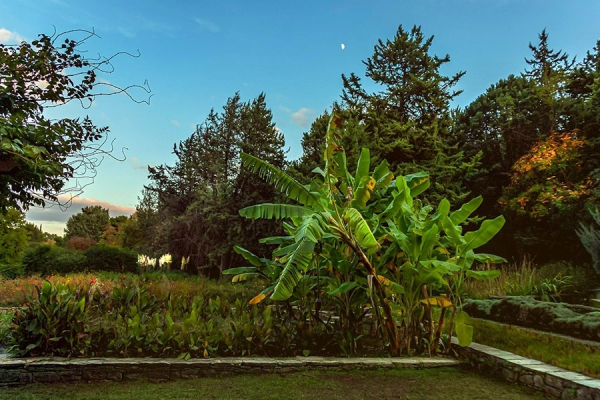
From the trees of the Old Testament to the plants of the future, the Julia and Alexander N. Diomedes Botanical Gardenin Chaidari (403 Iera Odos) is a living laboratory of nature, history and knowledge in Western Attica. A proud member of the Botanic Gardens Conservation International (BGCI), it is the largest botanical garden in Greece and the entire Eastern Mediterranean — a vast green lung overflowing with more than 2,500 species of trees and plants from around the world. It serves simultaneously as a center for research and education, and as a serene, inspiring space for leisure and recreation.
As stated on the Garden’s official website, “Beyond the high diversity of native and cultivated flora, the area also functions as an ideal natural refuge for fauna — being part of the permanent wildlife sanctuary of Mount Aigaleo–Poikilo (Government Gazette 918/B/, 18/07/2001). Protected from human interference, the ecosystem allows for the operation of a complete and undisturbed food web.”
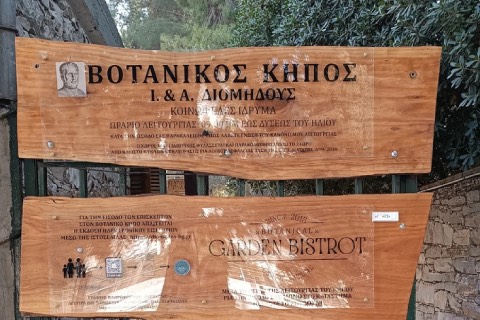
The Garden was founded by Royal Decree in 1951, based on the bequest of Academician Alexander N. Diomedes (1874–1950) and the donation of forest land from the Ministry of Agriculture, under the condition that its development would not alter the natural landscape. Thus, during construction, only minimal logging of pines and cypresses was permitted. The cultivated section was designed as a mixed ecosystem where native forest species coexist harmoniously with cultivated plants — a feature that makes the Diomedes Botanical Garden one of the most unique gardens of its kind worldwide.
Legally, the Garden is a Private Law Institution, governed by a five-member committee chaired by the Rector of the National and Kapodistrian University of Athens, as per the founder’s will. The other members include the Professor of Botany from the same university, the Governor of the National Bank of Greece, the President of the Supreme Court, and the Director of National Bequests at the Ministry of Finance.
The Garden was designed by Professor Hertha Hammerbacher, a leading landscape architect from the University of Berlin, while the supervision of the project was undertaken by the late Professor of Botany at the University of Athens, Konstantinos Mitrakos. The Diomedes Botanical Garden finally opened to the public in 1975, a hundred years after the birth of its visionary founder.
The Roots of a Greek Tradition
Although the Diomedes Garden is the largest, it is neither the first nor the only botanical garden in Greece. The country’s connection with botany goes back to antiquity: in the 4th century BCE, Theophrastus of Eresus — Aristotle’s student and the father of botany — founded the world’s first botanical garden near the river Ilissos in Athens.
Later, in 1835, the first botanical garden of modern Greece was established in the area still known as “Votanikos” in Athens, by Professor C. N. Fraas of the University of Athens. That garden once covered the entire Haseki Estate (120 acres). Over time, sections were allocated to the Agricultural University of Athens and the Higher School of Agriculture, yet a small part of that original garden survives to this day.
A Walk Through the Living Museum
A stroll through the Diomedes Botanical Garden is a journey through continents, myths, and centuries. The grounds are divided into thematic sections, each dedicated to different categories of plants and trees.
To the right of the main entrance, lies the Arboretum, composed of six zones hosting species from the Mediterranean, Oceania, South Africa, Asia, North and Central America — cedars, chestnuts, eucalyptuses, acacias, callistemons, the Theophrastus palm, sequoias, yuccas, agaves, and more.
To the left, visitors encounter the Historical Plants section, home to species mentioned in ancient Greek mythology and in the Old and New Testaments. Here, botany becomes storytelling: the olive tree, sacred to ancient Athens; the wild olive, whose branches crowned the Olympic victors; the laurel, dedicated to Apollo; ivy, symbol of Dionysus; the myrtle, sacred to Aphrodite, who hid her nakedness behind its branches after emerging from the sea; the fennel, in whose hollow stems Prometheus hid fire to bring to humankind; the narcissus, from which the ancients made perfumed oil; the acanthus, inspiration for Corinthian capitals; the hemlock, which ended the life of Socrates; the lily, emblem of purity; and the Christ’s thorn, from which, according to tradition, the crown of thorns was woven.
Each plant is accompanied by detailed signs, listing its ancient Greek names and the sources that mention them.
The Garden in Bloom
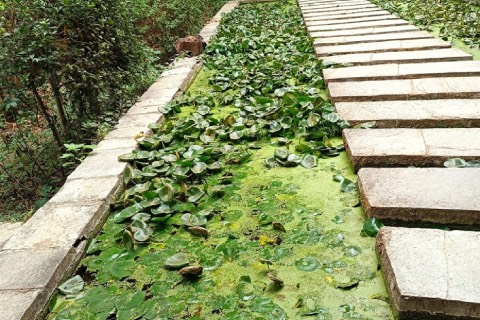
The Flower Garden (Anthōnas) is a feast for the senses — fifteen large flowerbeds and twenty-five ponds filled with water lilies and other aquatic or semi-aquatic species such as Lemna minor (duckweed), water hyacinths, and the sacred lotus of Egypt. During spring and summer, the air fills with fragrance from hundreds of rose varieties, pansies, anemones, hyacinths, dahlias, peonies, camellias, irises, oleanders, and fragrant climbing plants such as wisteria, jasmine, and honeysuckle — a dazzling panorama of colors and scents.
Walking along the cobbled paths shaded by tall bamboo, visitors find themselves under a cool canopy where sunlight filters softly through the slender leaves.
Plants of Purpose and Power
The section of Economically Useful Plants features species cultivated for their edible fruits, timber, fibers, or natural products: cork oak, camphor tree, varnish tree, cotton, tobacco, tapioca, flax, among others.
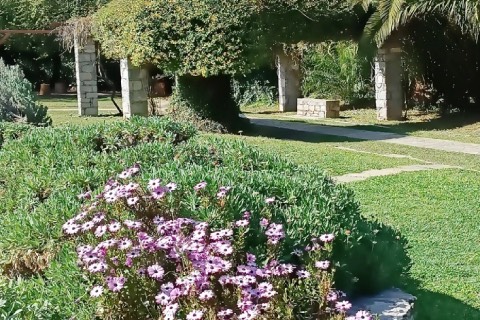
The Medicinal Plants area highlights herbs long revered for their healing properties — many of which are gaining new popularity today. Among them: Salvinia, one of Earth’s oldest plants, dating back over 200 million years; dittany, mandrake, St. John’s wort, rue, sage, rosemary, angelica, marjoram, and valerian.
No botanical garden would be complete without a Greenhouse: a protected environment where exotic plants from other climates grow under carefully regulated conditions — sugarcane, pepper, and the sensitive Mimosa pudica, known as “touch-me-not.”
Nearby, the Nursery nurtures endemic and rare species of Greek flora before they are transplanted into the Garden’s collections. Seeds are collected by the Garden’s staff across Greece or exchanged with over 300 botanical gardens worldwide, maintaining an active network of scientific collaboration.
The Herbarium preserves around 19,000 dried plant specimens, many originating from regions now designated as protected areas within the Natura 2000 network. A vast uncultivated area of the Garden stretches toward Mount Aigaleo, filled with evergreens, shrubs, and wild bulbs— a reminder that this sanctuary is as much wilderness as it is design.
A Place of Life and Memory
Seven years before its official founding — and thirty-one years before it opened to the public — this very ground witnessed a dark moment in Greek history. On September 8, 1944, 59 resistance fighters imprisoned by Nazi forces were executed here at dawn. Facing the machine guns, they sang the Greek national anthem until the gunfire drowned their voices. Among them were Lela Karagianni and Manolis Litinas, whose final message is still carved on a stone beside the monument listing all the names of the fallen.
Alexander Diomedes: The Visionary Behind the Garden
Behind the tranquil beauty of the Diomedes Botanical Garden lies the vision of Alexander N. Diomedes — one of the most remarkable figures in modern Greek history.
Born in Athens in 1875 into a prominent Spetses family of shipowners, scholars, and politicians, Diomedes grew up surrounded by letters, law, and civic duty. Following in his ancestors’ footsteps, he studied law and economics in Germany and France, earning his doctorate from the University of Leipzig in 1905.
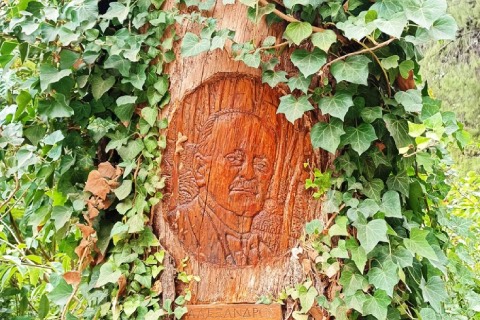
His career spanned law, politics, finance, and academia. A professor of Fiscal Law at the University of Athens, he also served as Governor of the National Bank of Greece, founder and first Governor of the Bank of Greece, and briefly as Prime Minister in the postwar national unity government. Though his political tenure was short, his influence on Greece’s economic and institutional development was profound — helping shape the banking system, modernize public administration, and stabilize the economy during turbulent decades.
Diomedes was also a scholar and writer, with a deep interest in Byzantine history. His Byzantine Studies earned him election to the Academy of Athens in 1945. He was married to Julia Psycha-Diomedes, a cosmopolitan philanthropist and Red Cross volunteer, known for her passion for plants and flowers — a love that would later bloom into legacy. After Julia’s death in 1946, Diomedes made a final, poetic gesture: he bequeathed his estate and fortune to the University of Athens to establish a botanical garden bearing both their names. His will specified that the garden should serve as a place of education, research, and love for the world of plants and trees.
When the Diomedes Botanical Garden finally opened its gates in 1975, it fulfilled that vision — not just as a scientific space, but as a living monument to the union of knowledge, nature, and memory.
BIBLIOGRAPHY
Pantelakis, S. Nikos. *Alexandros N. Diomedes [1874–1950]: An Authentic Representative of the Bourgeois Class.* Metamesonykties Editions, Athens, 2018.
Rizopoulou, Sofia. *Julia & Alexandros N. Diomedes Botanical Garden: From Human Nostalgia to the Timelessness of Plants.* Diavlos Publications, Athens, 2007.