

by George Dimos
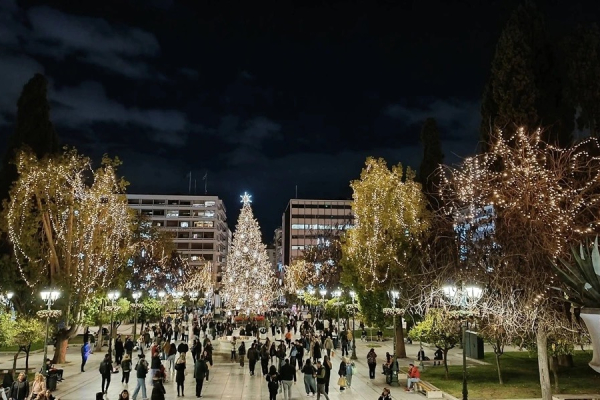
A walk through Athens’ decorated streets — especially in the evening — just a few weeks before Christmas officially begins leaves behind an almost exotic feeling. Large department stores on central avenues, such as Attica City Link at the beginning of Eleftherios Venizelos Avenue (Panepistimiou), change their entire color palette, with lights blinking in cheerful rhythms, while street musicians play well-known Christmas tunes on saxophone or violin. For a moment, it feels as if you are in another European city — one that bears little resemblance to the gloomy Athens of autumn, with its sudden rain showers and pigeons lined up on power cables, generously decorating anything unfortunate enough to stand beneath them for more than four minutes.
In the weeks leading up to and throughout the holiday season, Athens — animated by musical events and public happenings organized by a wide range of public and non-profit institutions — takes on the air of a Mediterranean version of Vienna or Berlin. From the Hellenic Red Cross, which recently invited Olympic champion Katerina Thanou to Syntagma Square to teach relay racing to young children, to ELIVIP, which in collaboration with STASY installed a temporary lending library in the multipurpose hall of Syntagma metro station, open to the public throughout the festive period, the city feels transformed. Fittingly, it is from Central Europe that the tradition of Christmas decoration historically made its way to Greece.
The custom of decorating a Christmas tree indoors began in Germany in 1539 and appeared in Greece after the establishment of the modern Greek state and the arrival of King Otto. The first documented Christmas tree in a Greek home is believed to have been decorated in 1843, on Kydathineon Street in Plaka, at the residence of diplomat Ioannis Paparrigopoulos. The fir tree, over two meters tall, adorned the home’s main sitting room and was decorated with candles and ornaments Paparrigopoulos had brought back from Russia, where he had served as consul general and studied law at a young age in Moscow. On Christmas Eve of that year, many visitors came to admire the tree and offer holiday wishes — among them General Ioannis Makriyannis, who found the foreign custom so peculiar that he famously remarked: “It’s beautiful, kyr-Gianni. May we be well next year too. But I don’t let my trees grow inside the room — only my weapons grow there.”
Festive winter decorations, however, were far from unfamiliar to ancient Athenians. The ancient custom of the Eiresione — an olive or laurel branch dedicated to Apollo, decorated with wool and the first fruits of the year and carried by children who sang as they paraded — can be seen as a precursor to both the Christmas tree and carol singing. Perhaps the ritual, which symbolized abundance and conveyed wishes for the new year, returned to Greece via Germany, where it became associated in the 8th century with Saint Boniface and later, in the 16th century, with Martin Luther, who is said to have been the first to decorate a fir tree with candles. Whatever path it followed through history, its meaning remained largely unchanged, surviving almost untouched the monumental transition from ancient polytheism to Christianity.