by Elena Dakoula
The beautiful, picturesque Plaka is not just a neighborhood; it is a way of moving through both the city and time itself. A place where the old has not receded, but quietly converses with the present through streets, courtyards, and spaces that are still in use. And perhaps this is why the tavernas there function not only as places for food and wine, but also as encounters with something that came before -stories, gestures, and memories that are not displayed, but simply remain.
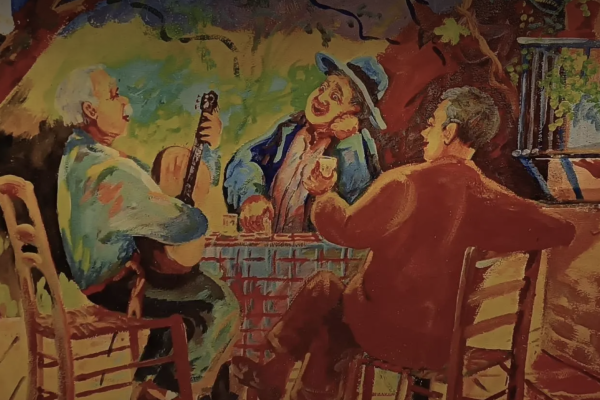
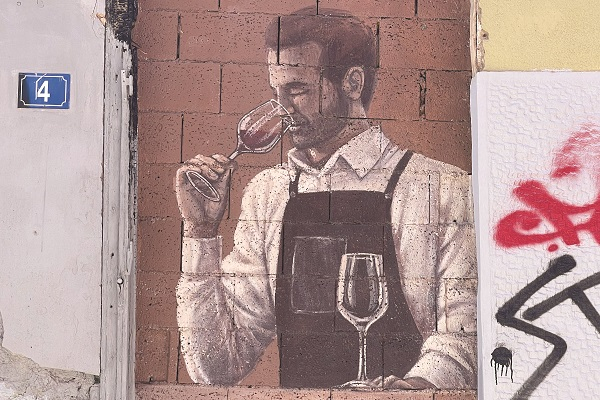
Among these spaces, there are a few -rare and distinctive- where the walls do not stay silent. They carry images not designed to impress, but to accompany life. And through these images flows the work of Giorgos Savvakis, who found in the tavernas of Plaka his natural canvas, transforming them into living snapshots of old Athens.
Giorgos Savvakis (1922–2004) was born in the neighborhood of Psyrri and lived almost his entire life in Plaka, a place that deeply shaped both the themes and style of his work. Self-taught, he began painting at an early age, without academic ambitions, but with the instinct of an observer and a profound connection to the everyday life of the city. His artistic journey essentially began in 1956, when, while working as a waiter at the Vakhos tavern in Plaka, he was encouraged by its then-owner, Vaggelis Oikonomopoulos, to paint the establishment’s walls. From that moment on, his painting found its natural environment: the walls of Plaka’s traditional tavernas.
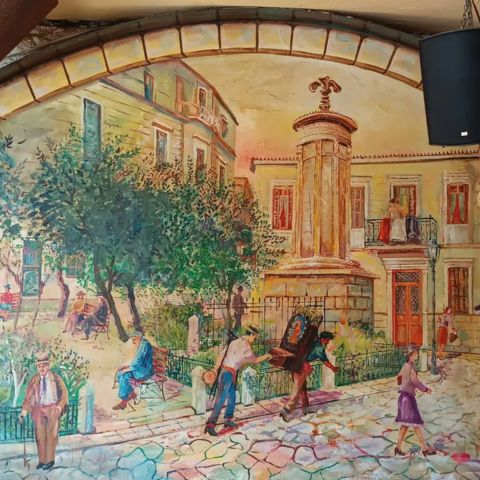
Between tables, wine, and music, Savvakis captured the world of everyday life: simple, direct human figures, scenes of leisure and entertainment, professions that have since disappeared, as well as streets and aspects of folk architecture and the social fabric of mid-20th-century Athens. His figures, lacking strict linear outlines, seem to still inhabit the space—like living memories of a city moving to the rhythm of shared company. His murals, with their vivid and luminous colors, were never mere decoration, but rather narration and collective memory. Through the apparent simplicity of his painting, his work tells the story of a way of life that is gradually fading, yet continues to breathe within his images.
In total, he created murals in more than 40 tavernas, leaving behind a legacy that became closely associated with the image of Plaka for decades and earned him the title of “the painter of tavernas”.
Although he worked abroad for a short period, mainly in Switzerland, Athens remained the constant axis of his artistic work. From the early 1970s onward, he also turned systematically to painting on canvas and wood, carrying the same folk sensibility into works that were exhibited both in Greece and abroad. In 1980, he held his first solo exhibition in Athens, followed by numerous other presentations and distinctions. In 1991, he was honoured in France with the title of Chevalier of the Olive Tree.
Today, Savvakis’ work functions as a visual archive of old Athens. His murals survive in tavernas such as Stamatopoulos, Saita, Spilia tis Akropolis, Geros tou Moria, and Palia Taverna tou Psarra, while 36 of them were designated in 2020 as Modern Monuments by the Ministry of Culture, recognised as vessels of cultural memory. The tavernas that host them are not merely dining spaces, but living fragments of a city that continues to tell its story through his work:
Stamatopoulos Taverna
The traditional Stamatopoulos tavern was founded in 1882 by the grandfather Stamatopoulos as a small grocery store that also served wine. From its earliest days, the space became a meeting point for groups of friends and musicians -including composer Nikolaos Kokkinos, alongside Dimitrios Rodios and Napoleon Lapathiotis, who are considered the creators of the serenade tradition. In this way, the tavern became closely linked with the flourishing of Greek operetta, gaining fame for its serenades, where notes and voices came together to create an atmosphere that still lingers in the memories of its longtime patrons.
Saita
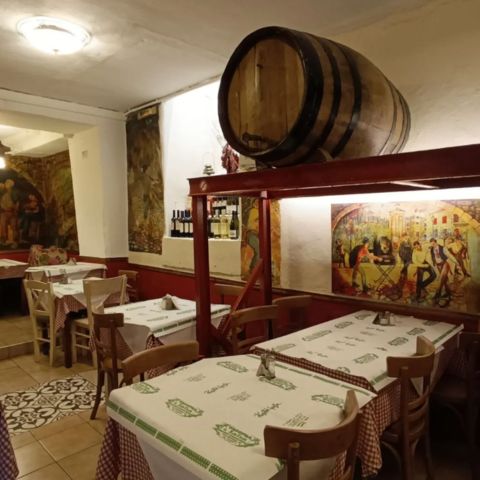
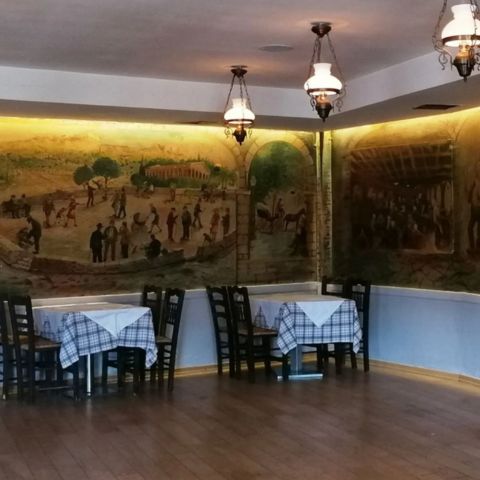
Subterranean, like most of the old Plaka tavernas, Saita spills its little tables out onto the pedestrian street of Kydathineon, one of the oldest roads in Plaka. Next to the small garden of the Church of the Transfiguration of the Saviour (Sotira tou Kottaki), with the busts of Konstantinos Tsatsos and Ioanna Seferiadi, its entrance invites you to descend a few steps and enter a space where past and present quietly converse. The interior still carries the feeling of an Athens that never truly disappeared.
The name Saita comes from a component of the traditional loom, and the space still retains the warmth of a family tradition. In 1970, Giorgos Zaharopoulos and his wife Vassiliki transformed the basement into a small tavern, adorned its walls with paintings of neighbourhood scenes, keeping an old icebox, and serving non other than retsina, of course, from Mesogaia.
Vassiliki cooked as her mother had before her -her mother having been a cook for officers of the Gendarmerie in Patras- while Giorgos gradually learned the secrets of the kitchen by her side, later passing this knowledge on to their children. Saita quickly became a cherished gathering place for artists and locals alike, where nights often unfolded into stories, music, and shared company. Today, Saita remains a family affair. Their daughter, Fotini, continues to cook the same traditional recipes, her husband serves the guests, and their other two children, Mary and Andreas, are also actively involved in the running of the taverna.
A special place in Saita’s memory is held by Giorgos Savvakis. “He was a personal friend of my parents”, Fotini recalls. “I’ve known him since I was born. He was a figure of Plaka -a small-built, very kind man, friendly, sociable, old-school, harmless”.
The painter passed away in 2004, quietly in his sleep. “The night before, we had met and watched a documentary about the loom together, here in Plaka. He was perfectly fine. And the next morning we learned that he had died”. His murals at Saita came to life spontaneously, no sketches, or any need for explanation. “Whenever he came to paint, he never told us what he would do. He simply did whatever he wanted”.
Today, the family continues the delicate work of preserving these murals, with the quiet awareness that the walls of Saita are more than part of a tavern, they are fragments of the city’s living memory, still breathing within Athens itself.
The Cave of the Acropolis
In the shadow of the Acropolis, quite literally beneath the sacred rock and just before the Anafiotika district, lies the taverna The Cave of the Acropolis. It is a place that seems to be in constant dialogue with the surrounding landscape, as well as with the stories of the people who have left their mark upon it.
Today, the tavern is owned by Kostas Binas and Kostas Ziogas; the former, in fact, has experienced it from within, having once worked here as a waiter. The tavern began operating in 1967. A few years later, in the early 1970s, Giorgos Savvakis also crossed its threshold. As Kostas Binas recalls, Savvakis was at that time still working as a waiter at the Vakhos tavern, but he was already painting on the side: “He worked on various themes. Some of the murals he later went over again, refreshing them. ‘The Revolution’ was among the first works he painted here”.
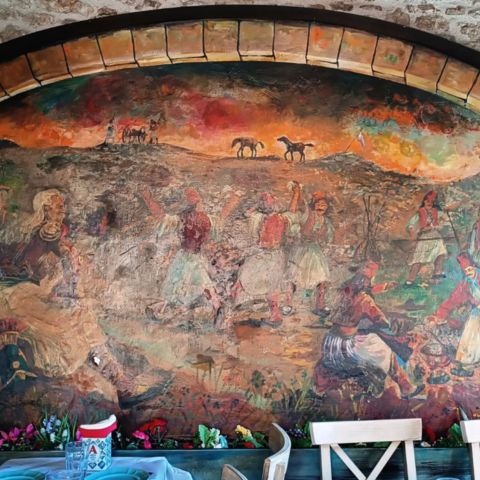
In the winter months, when the tavern did not operate at full capacity, Savvakis would spend long periods at the Cave. “He would stay for five to six months”, Kostas Binas remembers. “The owner back then, Mrs. Pagona Vazaia, would cook in the kitchen, while Savvakis painted”. He shared a close friendship and neighborly bond with the Vazaia couple, a relationship that shaped the daily life and atmosphere of the taverna during those years.
Geros tou Moria
The history of the taverna Geros tou Moria was shared with us by its current owner, Pantelis Kazakos, a man who first came to know the space as an employee, and later as the one who would carry forward its long legacy. As he recalls from earlier accounts, the taverna was founded in 1929 and originally occupied only the space where the kitchen is located today. In those days, kitchen and dining room flowed into one another as a single, shared space, with the sign “Wine and Beer Restaurant” prominently displayed at the entrance.
In the 1960s, Geros tou Moria became a landmark of Athenian social life. Newspapers frequently wrote about the taverna, as it was a gathering place for Greeks and international figures from the worlds of politics, business, and the arts. From Kennedy and Greta Garbo to Aristotle Onassis, to Aggelopoulos of Chalkor, and the merchant Alexandrakis -who, as Pantelis Kazakos recalls, always arrived wearing a bow tie, “he was a gentleman through and through”. The building also featured an upper level, which once housed the tavern Feggari (“Moon”). It was there that Rudolf Nureyev once danced, leaving his own mark on the history of the place.
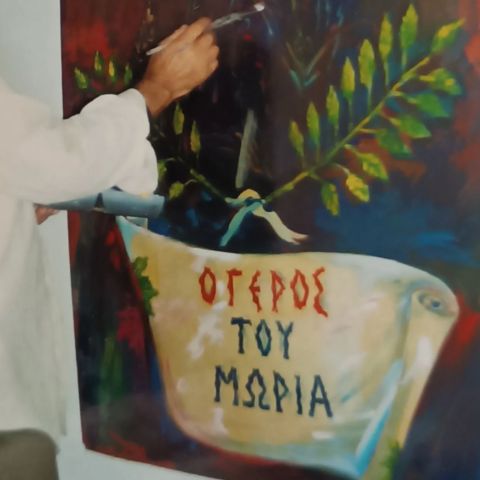
Over the years, the space expanded and in 1963 Giorgos Savvakis passed through Geros tou Moria. Pantelis Kazakos, who was working there as a waiter at the time, still remembers the murals the painter left behind. When he himself took over the taverna as owner in 2000, the works had already covered the entire space. During a later renovation, some painted tiles were removed, revealing only the main compositions, which continue to tell the story of the tavern, and of Plaka itself.
Palia Taverna tou Psarras
Founded in 1898, it is one of the oldest and most historic tavernas in Plaka, having never closed its doors, not even during times of war. In its early years, it mainly served seafood, while in the basement there were barrels of wine.
The name of the taverna comes from the surname of its owners, the brothers Dimitris and Giorgos Psarras. At one point, Dimitris left for Hollywood in pursuit of an acting dream. There, he met a wide circle of people and began sending Greek-American visitors back to Athens. In this way, the tavern’s reputation quietly crossed the Atlantic -so much so that, as it was said, “the whole of America knew it through him”.
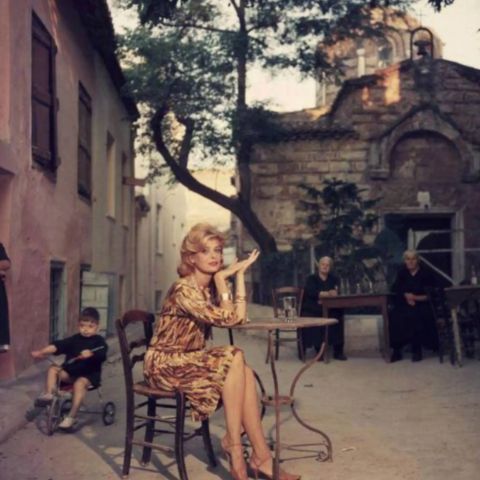
From the early 1950s onward, the tavern gained international attention after being mentioned in Views of Attica and its Surroundings by Rex Warner. The book offers a vivid reference to Giorgos Psarras -“the old man with the whiskers”, as he was affectionately known to his patrons- and to his celebrated retsina, which had already become part of the taverna’s identity. That mention proved pivotal. It opened the door for visitors from across the world: Laurence Olivier and Vivien Leigh, Margot Fonteyn, Graham Greene and Jean-Paul Belmondo, among others, who would all, at some point, find their way to this small Athenian table.