
by Niki-Maria Koskina
We visited her inaugural Greek presentation, an outdoor installation titled Untitled (Pride and Contempt), set within the grounds of the SNFCC. The exhibition takes its name from one of Kruger’s most powerful public works: the monumental phrase “Notice when pride becomes contempt”, inscribed across the exterior wall of the National Library of Greece. Curator Katerina Stathopoulou guided us through the works, unfolding the exhibition as one might turn the pages of a visual essay, carefully, deliberately, allowing each piece to speak in its own sharp cadence. Kruger herself is not present in Athens; she is currently immersed in a large-scale project destined for permanent installation at New York’s JFK Airport, soon to be unveiled.
Untitled (Pride and Contempt) at the SNFCC
Thirteen works by Barbara Kruger are presented on the Esplanade of the Stavros Niarchos Foundation Cultural Center, remaining on view until early November. These are among her first works to be shown in the Greek language, created specifically for this exhibition, addressing us directly, in our own linguistic space.
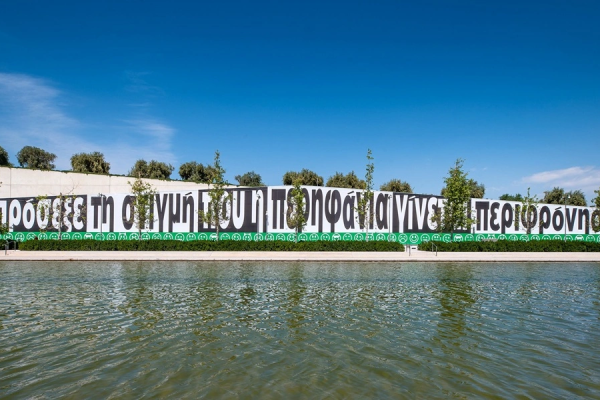
The exhibition’s central piece stretches 90 metres in length and rises to over 8 metres in height. It has been installed on the exterior wall of the National Library of Greece, following the architectural rhythm of Renzo Piano’s design. Unlike the other works, which are square in format, this monumental intervention bends and curves with the building itself. This dialogue with architecture is no coincidence. Kruger has long been attentive to the spaces that hold her work, treating walls not as neutral surfaces but as active participants in meaning. Her affinity for large-scale, site-specific installations reveals a sustained fascination with how language inhabits public space, how it presses against stone, glass and concrete and how it is shaped in return.
How was this work installed? As Gabriella Triantafylli, Director of Artistic Programming and Production at the Stavros Niarchos Foundation Cultural Center, explained to us, the process was demanding and time-consuming, so much so that, as she put it, “we managed to build a two-storey house with an attic”.
Since no external intervention on the building was possible, a specially designed metal structure was created and placed in direct contact with the wall, serving as the support onto which the work could be mounted. Because of its enormous length, the piece was not produced as a single print. Instead, it was divided into smaller sections, which were then carefully assembled on site, aligning precisely to form a seamless whole.
This installation at the SNFCC is one of the largest outdoor works ever exhibited by Barbara Kruger. As Katerina Stathopoulou noted, it is even larger than the piece the artist is currently preparing for JFK Airport in New York, which will measure 57 metres in length. Here in Athens, its scale is overwhelming, yet legible, designed to be read effortlessly whether one walks along the Canal beside the National Library or views it from across the water, where it asserts itself as both message and monument.
If you look closely, beyond the phrase itself, at the lower edge of the work, running across its entire length, the artist has placed a large number of emojis. This forms a kind of international “language”, one that can be understood everywhere on the planet, while also bringing the work closer to younger audiences, who are accustomed to using them in everyday communication.
On the opposite side of the Canal, in a dialogue with this imposing central work, the remaining twelve pieces of the exhibition are displayed across six metal structures, arranged in pairs. Here, we encounter works built around opposing pairs of striking, almost declarative reversals: “Truth is a myth,” “Good is bad,” “Wakefulness is sleep,” “Up is down,” “Right is wrong”…
All of Kruger’s phrases, rendered in black and white and green -a colour she has been using in her work for several years now, setting aside the red with which she has been most widely associated- remain open to interpretation. At the same time, they deliver sharp, immediate and forceful messages to the viewer, urging reflection and response. Green is also one of the artist’s personal favourite colours in everyday life. It is highly legible, while also carrying strong associations in the language of advertising, linked to brands and campaigns connected with “good causes”, such as organic products, recycling, and sustainability. At the same time, it feels particularly fitting for an outdoor exhibition, set amid trees and the natural greenery of the landscape.
The artist created these works exclusively for the Stavros Niarchos Foundation Cultural Center. The phrases were translated into Greek by Nicholas Yatromanolakis, following extensive discussions about the precise choice of words, an effort to capture as faithfully as possible the meanings Kruger had in mind when originally conceiving them in her native language. Once the translations were agreed upon, she designed the works directly in Greek. The printing was carried out in Greece, in accordance with her instructions and technical specifications, ensuring that the final pieces remained closely aligned with her artistic vision from concept to execution.
Stavros Niarchos Foundation Cultural Center (SNFCC), Syggrou Avenue 364, 17674 Kallithea, +30216 8091000
Until November 1st, 2026