

by Yannis Nenes
We all have memories of old urban and intercity buses — and even if we didn’t experience them ourselves, we certainly remember them from old Greek films and family photos from summer holidays. The old city and long-distance buses that once traveled across the roads of Greece have now become valuable pieces of our industrial heritage.
A journey through time with old Greek buses
A group of passionate collectors and researchers — led by brothers Haris and Vangelis Lazaropoulos — has devoted itself to the rescue and restoration of these historic vehicles. We entered this fascinating and almost magical world of industrial archaeology in search of why it captivates both specialists and the wider public. In doing so, we got to know the Greek group BusOldtimers Hellas (Old Greek Buses), their collection and activities, as well as how this effort fits into an international context of preserving our technological history. It was a friendly conversation, full of wonderful stories, with one of the Oldtimers, Mr. Haris Lazaropoulos.
Who BusOldtimers Hellas are
— Mr. Lazaropoulos, before we step onto the “Magic Bus” of history… who are you and your brother? What do you do — or what else do you do — when you’re not rescuing buses?
Welcome to this special route through time, with Old Greek Buses. Let us introduce ourselves. I am Haris, and next to me is my brother, Vangelis. We grew up in Palia Kokkinia in Piraeus, a neighborhood considered a “bus hub” because many old bus owners lived there. As early as the 1920s, there were transport entrepreneurs like our grandfather, Evangelos Argyrakis, who were seriously involved in urban transportation. We still remember families such as Ioannidou, Koukas, Mamma, Dioikitopoulos, Plataras, Varvaressos, and many others with whom we had social relations and contact. The history of most of these families with urban transport ended around the mid-1980s, when all the old buses built in Greece between 1957 and 1971 were withdrawn.
What do we do when we’re not saving buses? I am a journalist, working in the media since 1993, and at the same time the executive director of LAEGE, a company that supports television and film productions. My brother is an engineer-officer in the Merchant Navy, with excellent knowledge of mechanical engineering, metal structures, and metal analysis.
We are like the heroes of Valkanizater, the legendary film by Goritsas. For us, “it’s not about glory, it’s not about money — it’s the joy of the road,” especially when on that road there is a beautiful and safe old Greek bus (Nikos Portokaloglou, this one’s for you).
— What was the “first route”? Do you remember that moment when instead of saying “let’s go for coffee,” you said “let’s go save a bus”?
Our “first route” began in the early 1980s, when during days off or split shifts (“katsares”) the Scania Eleftheriadis 3/131 or the Mercedes Viamax 3/9 would stop in front of our grandmother’s house. We would come back from school and wouldn’t leave until it got dark. We played, studied, listened to stories — we lived it. At some point, one of the buses had to be withdrawn, and our mother would ask our father to keep it in the pilotis of our summer house so she could remember her youth. That bus was not saved, but my brother and I agreed to locate it and buy it as a commemorative gift for our mother.
Years later, in our teenage years, instead of going for coffee at Pasalimani, we started searching in scrapyards in Kifisos, Aspropyrgos, Elefsina, and Mandra. We found several buses, but not that 3/131. Eventually, we bought another Scania built by Eleftheriadis, and that is how our collection began.
— In the era of electric SUVs and bioclimatic stations, what exactly is BusOldtimers? A club, a rescue team, a hobby that got out of hand, or a kind of private museum on wheels?
BusOldtimers Hellas is a private initiative made up of a group of friends who love industrial archaeology, the style and design of another era, and who carry an unquenchable romantic spirit. Some of us have restored old buses, others contribute their driving skills, others their scientific knowledge, and we move through time as a completely independent, non-profit, ever-learning group of hobbyists doing what we truly enjoy.
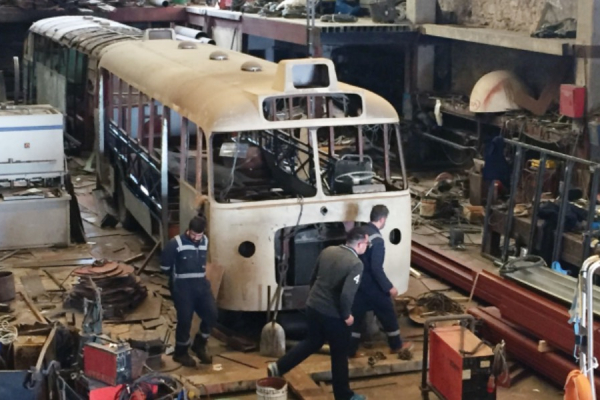
With our own resources, we have rescued more than twenty old Greek-built buses from 1946 to 1992. We have traveled abroad to meet like-minded people in Germany and Sweden, and we acquire anything that can enrich our archive (from photographs to mechanical manuals and construction sketches of frames and bodies).
Since 2006, together with two wonderful professors of the National Technical University of Athens, the late Simos Simopoulos and Dimitris Tsampoulas, we proposed the establishment of a National Transport Museum under a management body (structured as a public-private partnership). This initiative has been obstructed by certain rigidities, ideologies, and personal hostilities coming from some peculiar individuals who seem obsessed with the thought: “why hasn’t that wretched neighbor’s goat died yet,” just so they can derive some malicious satisfaction.
— So your grandfather was a bus owner and your mother drove until 1981. Are you continuing the story or writing your own?
Although educated, our grandfather Evangelos foresaw that urban transport would be a stable and worthwhile investment to support his family. He passed away early, in 1948, leaving behind four daughters, a wife and a sister who were widowed, as well as his elderly parents. Our late mother, Dionysia, remembered stories with her sisters — the struggle they went through to keep their father’s buses running and how hard they tried, in those times, to cope with responsibilities that other women could not even imagine.
Although Dionysia had graduated from the Jeanne d’Arc French School and held a degree in French literature, she often helped her older sister Argyro, who managed the business. During one of the major strikes, our mother was called upon to work as a conductor on the Scania. My brother was a baby, our father was away traveling, and she placed us in the double seat next to the conductor’s desk so she could complete her shift. We enjoyed the ride, and Dionysia did what had to be done.
As I grew older, I thought I would continue that story. The experiments and biases of politicians did not allow it. Later, I realized that I had a moral obligation to preserve that history as a social, political, and industrial legacy for future generations. Along this journey, I had the best allies: my brother, my wife and son, and the BusOldtimers friends.