

A slower geography of reservoirs, wetlands and thermal waters just beyond the capital
By Georgia Skamaga
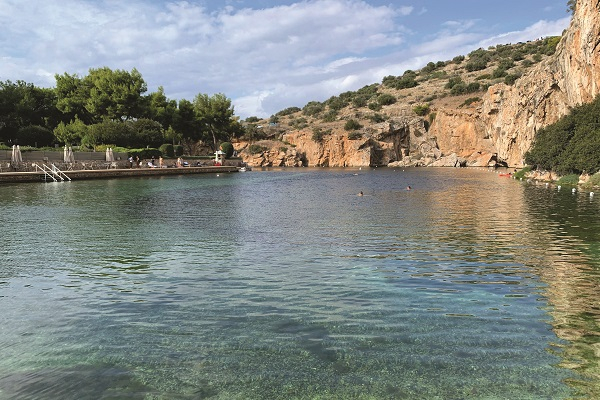
Limni Vouliagmenis. Photo by Omri Yamin / Unsplash
Athens moves in layers of heat, stone and sound. Ancient columns framed by traffic, café tables spilling into sidewalks, the sea always implied somewhere beyond the haze. But just outside this restless center, Athens softens. Not as coastline or Aegean horizon, but as stillness: reservoirs tucked into hills, wetlands dissolving into reeds, a thermal lake hidden among limestone. These are landscapes of subtle, measured and restorative pause:
Lake Vouliagmeni
Near the Athenian Riviera, Lake Vouliagmeni is hidden within limestone cliffs, a natural basin fed by subterranean thermal springs. Its waters remain steady and mineral-rich throughout the year, holding a gentle warmth that feels almost suspended in time. Unlike the nearby sea, the lake is enclosed and intimate, its shoreline carved into soft rock, its depths shifting between clarity and opacity. Tiny fish move through the shallows and the entire landscape feels quietly selfcontained, as if the earth has folded inward to create a place of rest. Swimming here is less an activity than an immersion into geological time. Beyond its waters, the lake extends into a slower ritual of wellbeing. A spa offers rejuvenating treatments, continuing the site’s natural emphasis on restoration, while the surrounding space also hosts private and corporate events, an unusual blend of leisure and gathering set against a mineral-blue horizon. At the lakeside restaurant, abra Ovata, chef John Skotidas and his team translate the richness of the Mediterranean into a contemporary culinary language. Dishes are shaped by seasonal, locally sourced ingredients, elevated into compositions that feel both precise and expressive. A coffee or meal here lingers easily, the water always within view, as if the lake refuses to leave the frame
Lake Marathon
North of Athens, Lake Marathon sits beneath the folds of Mount Penteli, a landscape shaped as much by engineering as by mythic association. Created in the early 20th century to supply water to the capital, the reservoir is restrained in expression yet striking in presence. The Marathon Dam, faced with Pentelic marble, anchors the scene with quiet authority. It is functional, but also symbolic: a meeting point between classical material and modern necessity. At dawn, the water becomes almost indistinguishable from the sky. The surface holds its stillness with precision, as if the entire landscape has been briefly paused.
Lake Iliki
Further northwest, Lake Iliki stretches outward with a sense of openness that feels almost uncomposed. Also a reservoir, it carries none of the urban proximity of Marathon. Instead, it reads as distance itself, long, quiet and uninterrupted. Reeds edge the shoreline. Birds move in slow arcs across the water. Wind reshapes the surface without urgency. There is little here to interpret. That is its appeal.
Lake Beletsi
High on the slopes of Mount Parnitha, Lake Beletsi feels unexpectedly soft against its mountainous setting. A small artificial lake created in the 1970s, it has since been reclaimed by nature, wrapped in pine forest and open sky. There is little ceremony here. No infrastructure to speak of, no smooth edges, just water held lightly within the landscape. Ducks drift across its surface and the surrounding hills rise and fall in quiet rhythm, as if the terrain itself is breathing more slowly. On still days, the lake becomes a near-perfect mirror, reflecting trees, sky and passing light with striking clarity. On windier afternoons, it shifts again, textured and restless. Lake Beletsi is a place for short walks, informal picnics and the simple pleasure of being slightly removed from the city without ever truly leaving it.
Schinias wetlands
On Attica’s eastern edge, Schinias unfolds as a protected wetland where pine forest, lagoon and sea converge. The landscape is in constant negotiation, freshwater meeting salt, sand shifting with wind, reeds bending toward open sky. Migratory birds trace seasonal paths overhead, turning the area into a moving map of passage and return. Even the silence here feels active, filled with subtle motion. It is one of the region’s most fragile landscapes and one of its most quietly alive.